Can I Go To Georgia Without NEET Exam? (MBBS in Georgia — What Indian Students Must Know)
If you’re reading this, chances are you’re frustrated. Maybe you didn’t crack NEET this year. Maybe you’re staring at a score that won’t get you into a government college—or even a decent private one without a ₹1 crore donation. Or maybe you’re a parent watching your child’s medical dreams slip away because of one exam.
Then someone—an agent, a friend, a Facebook ad—told you about Georgia. “Study MBBS abroad. No NEET required. English medium. Affordable fees. NMC-approved universities.”
It sounds perfect. Almost too perfect.
So you’re here asking the question that thousands of Indian families ask every year: Can I really go to Georgia without NEET and still become a doctor in India?
Here’s what I’m going to do in this article. I’ll give you the honest answer—no sugarcoating, no sales pitch. I’ll explain exactly what the rules are, why they exist, what the real risks are if you skip NEET, and what smart alternatives you actually have.
By the time you finish reading, you’ll know whether going to Georgia without NEET is a calculated risk or a expensive mistake. You’ll know what questions to ask consultants. And most importantly, you’ll know the safest path forward for your medical career.
Let’s start with what you came here for: the direct answer.

The Straight Answer: Can You Study MBBS in Georgia Without NEET?
Here’s the truth in one sentence:
Yes, some Georgian universities will admit you without NEET—but you cannot legally practice medicine in India without NEET, no matter where you study.
Let me break that down because this is where most confusion starts.
Two different things are happening here:
- University admission (what Georgian universities require)
- Indian medical licensing (what the National Medical Commission requires)
Many Georgian medical universities don’t ask for NEET during admission. They have their own criteria—usually your Class 12 marks in PCB, a valid passport, and tuition fees. From their side, you’re admitted. You can study. You’ll get a degree.
But here’s the problem: When you return to India, the National Medical Commission (NMC) won’t let you practice medicine unless you qualified NEET.
It doesn’t matter that you have an MBBS degree. It doesn’t matter that the university is NMC-recognized. Without NEET, you cannot:
- Register with the NMC as a doctor
- Get a medical license
- Work in any Indian hospital (government or private)
- Start your own clinic
- Appear for post-graduate entrance exams
Your expensive foreign degree becomes a decorative piece of paper.
When consultants say “NEET not required for Georgia,” they’re playing word games. Technically, they’re correct—for admission. But they’re hiding the bigger picture.
Here’s what’s really happening:
- They get their commission when you enroll
- They don’t care whether you can practice in India five years later
- They know confused, desperate students won’t ask the right questions
- By the time you realize the problem, you’re already ₹25–30 lakhs deep into your degree
I’m not saying all consultants are dishonest. But the ones who don’t clearly explain the NEET requirement upfront? They’re not working in your best interest.
What NEET Actually Means for Indian Medical Students
Why Does NEET Even Exist?
Before 2016, getting into medical college in India was chaos. Every state had different exams. Private colleges had their own entrance tests. Corruption was rampant—seats were sold, marks were manipulated, and students with money but no merit were getting into medical schools.
The Supreme Court stepped in and made NEET mandatory. One exam. One standard. One transparent process for the entire country.
The goal? Make sure every doctor in India meets a minimum level of competence before they even enter medical school.
The Rule That Changes Everything
The National Medical Commission (which replaced the old Medical Council of India in 2020) has one non-negotiable rule for Indian students studying abroad:
You must qualify NEET to get your foreign medical degree recognized in India.
This isn’t a suggestion. It’s not a guideline. It’s a legal requirement spelled out in the National Medical Commission Act, 2019.
Here’s the exact situation:
- If you studied MBBS in Georgia (or Russia, China, Ukraine, Kazakhstan, anywhere)
- And you want to come back and work as a doctor in India
- You MUST have qualified NEET before or during your MBBS programme.
- AND you must pass the FMGE (Foreign Medical Graduate Exam) or its replacement, NExT (National Exit Test)
Both requirements are mandatory. You can’t skip NEET and just pass FMGE. It doesn’t work that way.
NEET Isn't Just About Getting In—It's About Getting Licensed
This is the part that trips up most students.
They think: “NEET is just for admission. Once I have my MBBS degree, I’m a doctor.”
Wrong.
In India, NEET serves as proof of baseline eligibility. It’s the NMC’s way of saying, “This person met the minimum academic standard to study medicine.”
Without that proof, the NMC will not:
- Allow you to take FMGE/NExT (the licensing exam for foreign graduates)
- Register you as a medical practitioner
- Issue you a license to practice
- Recognize your degree for employment or further studies
You can have straight As in Georgia. You can be top of your class. You can have glowing recommendations. None of that matters without NEET.
What Happens If You Study in Georgia Without NEET?
Let’s walk through the nightmare scenario, because this happens to real students every year.
Year 1–5: You study in Georgia. Everything seems fine. You’re learning medicine, making friends, and enjoying student life.
Year 6: You graduate with your MBBS degree. You’re excited. You come home.
Year 6, Month 1: You apply to take FMGE/NExT so you can get licensed. The NMC asks for your NEET scorecard.
You don’t have one.
The NMC rejects your application.
Now what?
- You can’t practice medicine in India
- You’ve spent ₹25–35 lakhs on your degree
- You’ve lost 5–6 years of your life
- Your friends who took NEET are already working as doctors
- You’re back to square one
Your only option? Go back and qualify NEET now. Then reapply for FMGE/NExT.
But here’s the problem: You’re now 23–24 years old. You haven’t studied NEET material in 6 years. You’re competing against 18-year-olds who are fresh from coaching classes. And even if you crack NEET, you still have to pass FMGE/NExT, which has a pass rate of around 20–25%.
This is not a hypothetical. This happens to hundreds of students every year.
Yes. And that’s good. But it doesn’t solve your NEET problem.
Let me explain the difference:
NMC-recognized university = The university meets quality standards. Degrees from this university can be recognized in India—if you meet all the requirements.
NMC-eligible student = A student who has (1) qualified NEET, (2) graduated from a recognized university, and (3) passed FMGE/NExT.
The university being recognized is just one piece of the puzzle. You still need NEET.
Think of it like this: Harvard is a recognized university. But if you go to Harvard without a student visa, you’re not a legal student—no matter how good Harvard is. Same logic applies here.
Recent Changes You Need to Know (2024–2026)
The rules are getting stricter, not looser. Here’s what’s changed recently:
1. NExT is replacing FMGE The National Exit Test (NExT) will eventually replace FMGE as the final licensing exam. It will be the same exam for Indian and foreign medical graduates. This makes it even more important to have NEET, as NExT eligibility will strictly require it.
2. No more loopholes A few years ago, some students who went abroad without NEET were able to get their degrees recognized through court cases or exceptions. The NMC has closed those loopholes. If you enroll now without NEET, there’s no way around it later.
3. Stricter verification The NMC is now cross-checking NEET scorecards more carefully. They’re also verifying that students actually attended classes in person (not online degrees), stayed in the country during their studies, and completed clinical rotations in recognized hospitals.
Why This Rule Will Never Change
Some students think, “Maybe they’ll relax the rule in a few years.”
They won’t. Here’s why:
The Indian healthcare system already has serious quality control issues. Quacks and unqualified practitioners are everywhere. The NMC’s entire mandate is to raise standards, not lower them.
Removing the NEET requirement would:
- Destroy the credibility of Indian medical education
- Allow anyone with money to become a doctor (we tried that—it didn’t work)
- Put patients at risk
- Violate the Supreme Court’s orders
The NEET requirement is here to stay. Plan accordingly.
What’s next: Now you understand the rules. But here’s where it gets tricky—understanding the difference between admission and the right to practise. That’s the trap most students fall into, and we’ll break it down in the next section.

How International Student Agency Helps Students Do This Safely
Choose MBBS in Georgia?
MBBS in Georgia is a valid and viable option for Indian students who wish to pursue medical education abroad. The combination of affordable fees, quality education, English medium instruction, and international recognition makes it attractive. However, success requires careful planning, choosing the right NMC-recognized university, and dedicated preparation for the FMGE/NExT examination.
Before making your decision, consider your financial situation, academic capabilities, adaptability to new environments, and commitment to clearing the screening test. Research thoroughly, verify university credentials, and perhaps connect with current students or alumni to get firsthand insights.
With proper preparation and determination, an MBBS degree from Georgia can be your pathway to a successful medical career in India or internationally. The key is to stay focused on your goal, work hard during your studies, and prepare diligently for the licensing examination.
Remember, the medical profession demands dedication regardless of where you study. Whether in India or Georgia, your commitment to learning and patient care will ultimately define your success as a doctor.
Disclaimer: Disclaimer: Medical education regulations and university recognition status can change regulations and university recognition status can change. Always verify the latest information from official sources like the National Medical Commission (NMC) website and the respective university websites before making admission decisions.
👉 Free Application Review – Limited Seats for 2026 Intake
📞 WhatsApp Counselling Available
📄 Document Verification at No Cost
Best wishes for your medical education journey!
Are you planning to pursue MBBS in Georgia? Have questions about the admission process or life as a medical student there? Feel free to research further and consult with educational advisors to make an informed decision about your medical education journey.
Have questions about the admission process? Drop them in the comments below. We try to respond within 24 hours.
Found this guide helpful? Please share it with other students planning to study MBBS in Georgia; knowledge shared is knowledge multiplied.
FAQs: Is MBBS in Georgia Valid in India?
Yes, many Georgian medical universities will admit students without a NEET score. They have their own admission criteria based on Class 12 marks in Physics, Chemistry, and Biology. However, admission without NEET doesn't mean you can practice medicine in India later—NMC requires NEET for licensing.
No. Even if you graduate from an NMC-recognized Georgian university, your degree cannot be registered with the National Medical Commission unless you qualified NEET before or during your MBBS. Without NMC registration, you cannot legally practice medicine in India.
No. The NMC clearly states that Indian students must have qualified NEET to be eligible to appear for FMGE (Foreign Medical Graduate Examination) or NExT (National Exit Test). Without a valid NEET scorecard, your FMGE/NExT application will be rejected.
Studying abroad without NEET is not illegal—universities can admit you based on their criteria. However, it's a risky decision because you won't be able to practice in India without qualifying NEET later. You'll have a degree but no license to work as a doctor.
If you absolutely must go without NEET, ensure you get: (1) Written confirmation that the university is NMC-recognized, (2) Proof that instruction is in English medium, (3) Details of affiliated teaching hospitals for clinical training, (4) Clear refund/exit policy if you need to withdraw, and (5) Conditional admission letter stating you'll complete NEET before graduation.
Be very careful. Agents saying "NEET not required" are technically correct—for university admission. But they often don't explain that NEET is mandatory for practicing in India. Always ask: "Can I practice in India without NEET?" If they say yes, they're lying. Get everything in writing and verify with the NMC directly.
Technically yes, but it's extremely difficult. You'll be 23–24 years old competing against 18-year-olds fresh from coaching. Even if you clear NEET, you still need to pass FMGE/NExT (20–25% pass rate). It's far better to clear NEET before going to Georgia than trying to do it after 5–6 years.
You'll have an MBBS degree but cannot get it registered with the NMC. This means you cannot work in any hospital (government or private), cannot open a clinic, cannot appear for PG entrance exams, and cannot legally practice medicine. Your degree becomes unusable until you qualify NEET and pass FMGE/NExT.
No. The NMC has made it clear that all Indian citizens and OCIs who study medicine abroad must have qualified NEET to get their degree recognized in India. Previous loopholes have been closed. Court cases are rarely successful. The rule is absolute.
The safest path: (1) Qualify NEET first, (2) Apply to NMC-recognized Georgian universities, (3) Ensure the university offers English-medium instruction and proper clinical training, (4) Maintain all documentation, (5) Pass FMGE/NExT after graduation, and (6) Complete mandatory internship. This is the only guaranteed legal route to practice in India.
Get Personalized Budget Plan
-

MBBS Fees in Kyrgyzstan in Indian Rupees (2026 Cost Guide)
MBBS Fees in Kyrgyzstan in Indian Rupees (2026 Cost Guide) Blogs ... -
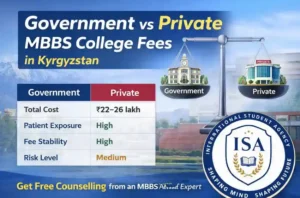
Government vs Private MBBS Fees in Kyrgyzstan – Detailed Comparison
Government vs Private College Fees Government vs Private College Fees Blogs ... -
Year-Wise MBBS Fee Structure in Kyrgyzstan (2026 Guide)
Year-Wise MBBS Fee Structure in Kyrgyzstan (2026 Guide) Blogs About Us Year-wise... -
MBBS Fees in Kyrgyzstan 2026 – Total Cost & Fees in Rupees
Does NMC Recognize Georgian Medical Universities? Complete Truth for Indian Students... -
Does NMC Recognize Georgian Medical Universities? Complete Truth (2026)
Does NMC Recognize Georgian Medical Universities? Complete Truth for Indian Students... -
How to Check NMC Compliance of Georgian Medical Universities (2026 Guide)
Will My MBBS Degree from Abroad Be Valid in India? (2026...