What Is The NEET Score For MBBS In Georgia? (Complete Guide for Indian Students 2026)
So you’ve decided Georgia is where you want to study MBBS. Smart choice—affordable tuition, quality education, English-medium programs, and NMC-recognized universities. But now comes the question every How NEET scores impact your eligibility for practice in India asks:
“What NEET score do I need to get into a Georgian medical university?”
It’s a confusing topic. You’ll find different answers everywhere. Some consultants say “just pass NEET.” Others mention specific percentiles. Some even claim the score doesn’t matter at all. And if you’re a parent trying to figure this out, the contradictory information can be overwhelming.
Here’s what makes this tricky: Georgian universities and Indian regulations have different requirements. What the university asks for admission is one thing. What the National Medical Commission (NMC) requires for you to practice in India later is another.
In this guide, I’m going to clear up all the confusion. You’ll learn:
- The exact NEET score requirements for Georgian universities
- What the NMC actually mandates for Indian students
- Whether your NEET score affects which university accepts you
- How NEET scores impact your eligibility for practice in India
- What to do if your NEET score is low but you still want to study abroad
By the end, you’ll know exactly where you stand and what your next steps should be.
Let’s start with the straightforward answer.
The Direct Answer: What NEET Score Do You Need?
Here’s the truth in the simplest terms possible:
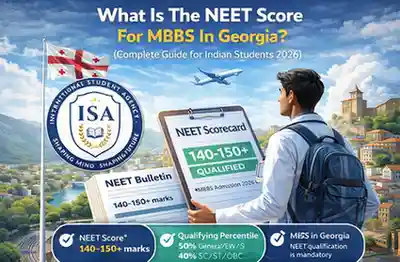
To study MBBS in Georgia and practice in India, you need to qualify NEET—which means scoring at least the 50th percentile (General category) or 40th percentile (reserved categories).
Let me break this down:
What “Qualifying NEET” Actually Means
The NMC doesn’t care about your exact NEET score or rank. They care about one thing: Did you qualify?
“Qualifying” NEET means you scored:
- 50th percentile or above (General/EWS category)
- 40th percentile or above (SC/ST/OBC categories)
- 45th percentile or above (PwD category, if applicable)
In terms of actual marks (out of 720), this typically translates to:
- General/EWS: Around 720–140 marks (varies each year based on difficulty)
- SC/ST/OBC: Around 720–125 marks
- PwD: Around 720–130 marks
Important: The exact marks change every year because NEET uses percentile-based cutoffs, not fixed marks. What matters is whether you’re above the percentile cutoff for your category.
What Georgian Universities Actually Require
Here’s where it gets interesting.
Most Georgian medical universities don’t set a minimum NEET score for admission. Their official requirement is simply:
✓ You must have qualified NEET (i.e., scored above the percentile cutoff)
That’s it. Whether you scored in the 50th percentile or the 99th percentile usually doesn’t matter to them.
Their admission criteria typically include:
- Valid NEET qualification certificate
- Minimum 50% aggregate in Physics, Chemistry, Biology in Class 12 (40% for reserved categories)
- Age: 17 years minimum, usually no upper age limit
- Valid passport
- Ability to pay tuition fees
So in practical terms: If you’ve qualified NEET, most Georgian universities will accept you regardless of your exact score.
Why This Matters
This is actually great news if you’re in this situation:
- You qualified NEET but didn’t get a good rank
- You can’t afford private medical colleges in India (₹50 lakhs–₹1.5 crore)
- Government college seats are out of reach with your rank
- You want to become a doctor without compromising your family’s finances
Georgia becomes a viable, affordable option. You’re not competing for seats based on rank—you just need to have cleared the cutoff.
Understanding NEET Requirements: NMC Rules vs University Rules
This is where most confusion happens. Let me explain the difference clearly.
What the NMC (National Medical Commission) Requires
The NMC’s rules are about eligibility to practice in India, not about university admission.
According to NMC regulations:
Indian students studying MBBS abroad must have qualified NEET in the year they’re seeking admission (or the previous year) to be eligible for registration in India.
Key points:
- You must have qualified NEET (met the percentile cutoff)
- Your NEET score must be from the same year or previous year as your admission
- This is mandatory for appearing in FMGE/NExT (the licensing exam for foreign medical graduates)
- Without NEET qualification, your foreign degree cannot be registered in India
The NMC doesn't care about your rank. They only care that you qualified.
What Georgian Universities Require
Georgian universities set their own admission standards. Here’s what they typically look for:
Academic Requirements:
- 50% minimum aggregate in PCB in Class 12 (General)
- 40% minimum aggregate in PCB (SC/ST/OBC)
- NEET qualification certificate
Documentation:
- Valid passport
- Birth certificate
- Class 10 & 12 mark sheets and certificates
- NEET scorecard/admit card
- Medical fitness certificate
- Police clearance certificate (for visa)
Financial:
- Proof of ability to pay tuition fees (varies by university: $4,000–$8,000/year)
- Proof of funds for living expenses
Most universities do not have:
- Minimum NEET rank requirements
- Entrance exams of their own
- Donation or capitation fees
- Seat quotas based on NEET scores
The Key Difference
Let me put this in a simple table:
| Requirement | NMC (India) | Georgian Universities |
|---|---|---|
| NEET qualification | Mandatory | Mandatory |
| Specific NEET score/rank | Not required | Not required |
| Purpose | Eligibility to practice in India | Eligibility for admission |
| When it matters | When you return to India for licensing | During university application |
Bottom line: Both require NEET qualification. Neither cares about your exact score or rank. You just need to have cleared the cutoff.
Do Different Universities Have Different NEET Cutoffs?
This is a common question, and the answer might surprise you.
Most Georgian Universities: No Specific Cutoff
The majority of well-established, NMC-recognized Georgian medical universities do not set minimum NEET scores beyond the basic qualification requirement.
Universities like:
- Tbilisi State Medical University (TSMU)
- Batumi Shota Rustaveli State University
- University of Georgia (UG)
- Georgian National University SEU
- Caucasus International University
- European University
All of these accept students who have simply qualified NEET, regardless of their rank or exact score.
Why Don't They Set Cutoffs?
Several reasons:
- Demand vs. Supply: Georgian universities have more seats available than Indian applicants. They don’t need to be selective based on NEET ranks.
- Different Education System: They assess students based on their own academic standards, not just one entrance exam.
- Financial Model: These are tuition-based universities. As long as you meet minimum academic standards and can pay fees, you’re admitted.
- International Student Mix: They admit students from many countries, not just India. NEET is only relevant for Indian students.
A Few Exceptions
Some newer or less-established universities might prefer students with higher NEET scores for marketing purposes (“Our students have high NEET ranks”). But this is rare and not an official requirement.
Important warning: If a consultant tells you a university requires a specific NEET score (like “minimum 400 marks” or “must be in top 50%”), verify this directly with the university. It might be the consultant’s own filtering, not the university’s actual policy.
What Actually Affects Your Admission Chances
Since NEET score usually doesn’t matter beyond qualification, what does?
Factors that matter more:
- Class 12 marks in PCB: Universities do check this. Aim for 60%+ to be safe.
- English proficiency: Can you handle English-medium instruction? Some universities may check this informally.
- Application timing: Earlier applications often have smoother processes.
- Documentation completeness: Missing or incorrect documents cause delays or rejections.
- Financial readiness: Can you show proof of funds for fees and living expenses?
Your NEET rank matters very little as long as you’ve qualified.
Get Free Counselling
Choose MBBS in Georgia?
NEET Score and FMGE/NExT: What You Need to Know
Qualifying NEET gets you into Georgia. But there’s another exam waiting when you come back: FMGE (Foreign Medical Graduate Examination) or its replacement, NExT (National Exit Test).
The Second Hurdle: FMGE/NExT
After completing your MBBS in Georgia, you must pass this screening exam to practice in India. Here’s what you should know:
About FMGE/NExT:
- It tests your medical knowledge across all subjects
- Pass rate is typically 20–30% (it’s tough)
- You can attempt it multiple times
- You must qualify NEET to even appear for this exam
Does Your NEET Score Affect FMGE/NExT?
Directly? No.
Your NEET score from 5–6 years ago doesn’t determine your FMGE/NExT result.
Indirectly? Maybe.
Students who scored well in NEET tend to have stronger fundamentals in basic sciences (Physics, Chemistry, Biology). These fundamentals help during medical school and eventually during FMGE/NExT preparation.
But here’s the truth: Your performance in Georgia matters far more than your old NEET score.
If you:
- Study consistently during your 5 years in Georgia
- Take clinical rotations seriously
- Start FMGE/NExT prep in your final year
- Use good study materials
…then your NEET score becomes irrelevant. Many students with average NEET scores pass FMGE/NExT on their first attempt because they worked hard during their MBBS.
The Real Predictor of Success
What actually predicts whether you’ll pass FMGE/NExT?
- How seriously you took your studies in Georgia (not partying through 5 years)
- Quality of clinical exposure during your training
- Dedicated FMGE/NExT preparation (6–12 months of focused study)
- Practice with previous year papers and mock tests
- Your determination and mental resilience
Your NEET score from years ago? Not even in the top 10 factors.
What If Your NEET Score Is Low (But You've Qualified)?
Let’s say you qualified NEET but barely—maybe you’re at the 50th percentile with a modest rank. Can you still pursue MBBS in Georgia successfully?
Absolutely yes. Here’s why and how.
Low NEET Score Doesn’t Mean Low Potential
Your NEET score reflects:
- How you performed on one exam
- On one particular day
- After preparing for one specific test format
- Under extreme pressure (20+ lakh students competing)
It doesn’t define your intelligence, your dedication, or your ability to become a good doctor.
Many students who score average on NEET go on to excel in medical school because:
- Medical education is different from entrance exam prep
- Clinical skills matter more than speed-solving MCQs
- Consistency over 5 years beats one-day performance
- Practical learning suits some students better than theory cramming
What You Should Focus On
If your NEET score is low but you’ve qualified, here’s your action plan:
1. Strengthen Your Basics
Before going to Georgia, spend 2–3 months revising:
- Basic concepts in Anatomy, Physiology, Biochemistry
- Medical terminology (you’ll encounter this immediately)
- English medical terms (since instruction is in English)
This foundation will help you hit the ground running in Georgia.
2. Choose the Right University
With a lower NEET score, prioritize universities that offer:
- Strong teaching support (smaller class sizes, accessible professors)
- Good clinical exposure (affiliated hospitals with diverse cases)
- Indian student support systems (seniors who can guide you)
- Solid FMGE/NExT coaching (built into the curriculum or available nearby)
Universities like TSMU, Batumi State University, and University of Georgia are known for supporting students of all levels.
3. Commit to Consistent Study
You can’t coast through medical school. Make a commitment:
- Attend all lectures and practicals
- Study daily, even if just 2–3 hours
- Form study groups with serious students
- Don’t skip clinical rotations—this is where real learning happens
- Start FMGE/NExT prep early (from 3rd or 4th year)
4. Use Your Low Score as Motivation
Some of the best doctors I’ve known had average entrance exam scores. Why? Because they worked twice as hard to prove themselves.
Use your NEET score as fuel. Let it motivate you to show that you’re more than one test result.
Common Myths About NEET Scores for Georgia
Let me bust some myths you’ve probably heard:
Myth 1: “Higher NEET score = better university placement”
Reality: Most Georgian universities don’t consider your NEET rank for admission. They only check if you’ve qualified. A student with 500 marks and a student with 650 marks will get into the same university with the same ease (assuming both have qualified).
Myth 2: “You need at least 400+ marks in NEET for Georgia”
Reality: The only requirement is qualifying—which can be as low as 140–150 marks depending on the year and category. Anything beyond that doesn’t matter for admission.
Myth 3: “Low NEET score means you’ll fail FMGE”
Reality: NEET and FMGE test different things. NEET is a pre-medical entrance exam. FMGE is a post-graduation medical licensing exam. What matters is how you study during your MBBS, not your NEET score from years ago.
Myth 4: “Georgian universities reserve seats for high NEET scorers”
Reality: There’s no seat reservation based on NEET scores. Georgian universities operate on a first-come-first-served basis with rolling admissions (as long as you meet minimum criteria).
Myth 5: “You can’t get a scholarship without high NEET scores”
Reality: Scholarships in Georgia are rare and usually based on financial need or outstanding academic performance during the MBBS program, not on NEET scores.
Step-by-Step: How to Use Your NEET Score for Georgia Admission
Let me give you a practical roadmap:
Step 1: Check If You’ve Qualified
Go to the official NEET website and verify:
- Your percentile score
- Whether you’re above the cutoff for your category
- Your NEET scorecard is downloadable
If you’ve qualified, you’re eligible. That’s all that matters.
Step 2: Research NMC-Recognized Universities
Visit the NMC website and download the list of recognized foreign universities. Filter for Georgia. As of 2026, there are several well-established options.
Don’t rely only on consultant recommendations—verify NMC recognition yourself.
Step 3: Check University Requirements
Visit the official websites of your shortlisted universities. Look for:
- Admission requirements (most will just say “NEET qualified”)
- Tuition fees
- Hostel facilities and costs
- Affiliated teaching hospitals
- Medium of instruction confirmation (must be English)
Step 4: Prepare Your Documents
Gather everything you’ll need:
- NEET scorecard/admit card
- Class 10 & 12 certificates and mark sheets
- Passport (if you don’t have one, apply now—it takes time)
- Birth certificate
- Medical fitness certificate
- Recent passport-size photographs
- Bank statements (for visa proof of funds)
Step 5: Apply Directly or Through Verified Consultants
Option A: Direct application (recommended if you’re confident)
- Email the university’s international admissions office
- Fill out their online application form
- Submit documents directly
- Follow up regularly
Option B: Through consultants (if you need hand-holding)
- Choose consultants with proven track records
- Verify they don’t charge excessive fees (application should be ₹50,000–₹1,00,000 max for services)
- Make sure they’re transparent about all costs
- Get everything in writing
Step 6: Don’t Worry About Your Exact Score
Remember: your NEET qualification is your ticket. Your rank is just a number on paper. What happens after you reach Georgia depends entirely on your effort, not your past score.
MBBS in Georgia is a valid and viable option for Indian students who wish to pursue medical education abroad. The combination of affordable fees, quality education, English medium instruction, and international recognition makes it attractive. However, success requires careful planning, choosing the right NMC-recognized university, and dedicated preparation for the FMGE/NExT examination.
Before making your decision, consider your financial situation, academic capabilities, adaptability to new environments, and commitment to clearing the screening test. Research thoroughly, verify university credentials, and perhaps connect with current students or alumni to get firsthand insights.
With proper preparation and determination, an MBBS degree from Georgia can be your pathway to a successful medical career in India or internationally. The key is to stay focused on your goal, work hard during your studies, and prepare diligently for the licensing examination.
Remember, the medical profession demands dedication regardless of where you study. Whether in India or Georgia, your commitment to learning and patient care will ultimately define your success as a doctor.
Disclaimer: Disclaimer: Medical education regulations and university recognition status can change regulations and university recognition status can change. Always verify the latest information from official sources like the National Medical Commission (NMC) website and the respective university websites before making admission decisions.
Coming up next: We’ll cover what documents you need, how the admission process works, expected costs, and what life is actually like for Indian students in Georgia.
👉 Free Application Review – Limited Seats for 2026 Intake
📞 WhatsApp Counselling Available
📄 Document Verification at No Cost
Best wishes for your medical education journey!
Are you planning to pursue MBBS in Georgia? Have questions about the admission process or life as a medical student there? Feel free to research further and consult with educational advisors to make an informed decision about your medical education journey.
Have questions about the admission process? Drop them in the comments below. We try to respond within 24 hours.
Found this guide helpful? Please share it with other students planning to study MBBS in Georgia; knowledge shared is knowledge multiplied.
FAQs: Is MBBS in Georgia Valid in India?
You need to qualify NEET, which means scoring at least the 50th percentile (General/EWS) or 40th percentile (SC/ST/OBC). In terms of marks, this is typically around 140–150+ marks out of 720 for General category, but the exact cutoff varies yearly. Most Georgian universities don't require a specific score beyond this qualification.
Yes, absolutely. As long as you've qualified NEET (met the percentile cutoff for your category), Georgian universities will accept you. They don't filter students based on NEET ranks. A student who barely qualified has the same admission chances as someone who scored 600+ marks.
If 200 marks puts you above the qualifying percentile cutoff for your category (typically yes for General category), then you can study in Georgia. The exact NEET score doesn't matter—only whether you've qualified according to NMC norms.
No. Georgian medical universities do not consider NEET ranks for admission decisions. Their criteria include: NEET qualification (yes/no), Class 12 PCB percentage (usually 50%+ required), valid documentation, and ability to pay fees. Your rank is irrelevant.
Not directly. FMGE/NExT is taken 5–6 years after NEET, and your performance depends on how well you studied during your MBBS in Georgia, not your old NEET score. Many students with average NEET scores pass FMGE/NExT because they worked hard during medical school.
Yes. While Georgian universities set their own admission criteria, the NMC (National Medical Commission of India) requires all Indian students to have qualified NEET to practice in India later. So practically, NEET qualification is mandatory even if the university itself might be flexible.
Unfortunately, you cannot study MBBS in Georgia (and practice in India) without qualifying NEET, regardless of your Class 12 marks. The NMC rule is non-negotiable: NEET qualification is mandatory for Indian students studying medicine abroad if they want to practice in India.
Generally, no. Georgian universities rarely offer scholarships based on NEET scores. If scholarships are available, they're usually based on financial need or exceptional academic performance during your MBBS, not your entrance exam score. Don't expect NEET-based scholarships.
The NMC doesn't restrict NEET attempts. However, your NEET qualification must be from the same year or previous year as your admission. A NEET score from 3–4 years ago won't be valid—you'll need to reappear and qualify fresh.
You'll need: (1) NEET scorecard showing you've qualified, (2) NEET admit card, (3) Category certificate (if applicable for reserved category cutoffs), and (4) NEET qualification/eligibility certificate. Keep both digital and physical copies, and get them attested if required by the university.
Get Personalized Budget Plan
-

MBBS Fees in Kyrgyzstan in Indian Rupees (2026 Cost Guide)
MBBS Fees in Kyrgyzstan in Indian Rupees (2026 Cost Guide) Blogs ... -
Government vs Private MBBS Fees in Kyrgyzstan – Detailed Comparison
Government vs Private College Fees Government vs Private College Fees Blogs ... -
Year-Wise MBBS Fee Structure in Kyrgyzstan (2026 Guide)
Year-Wise MBBS Fee Structure in Kyrgyzstan (2026 Guide) Blogs About Us Year-wise... -
MBBS Fees in Kyrgyzstan 2026 – Total Cost & Fees in Rupees
Does NMC Recognize Georgian Medical Universities? Complete Truth for Indian Students... -
Does NMC Recognize Georgian Medical Universities? Complete Truth (2026)
Does NMC Recognize Georgian Medical Universities? Complete Truth for Indian Students... -
How to Check NMC Compliance of Georgian Medical Universities (2026 Guide)
Will My MBBS Degree from Abroad Be Valid in India? (2026...