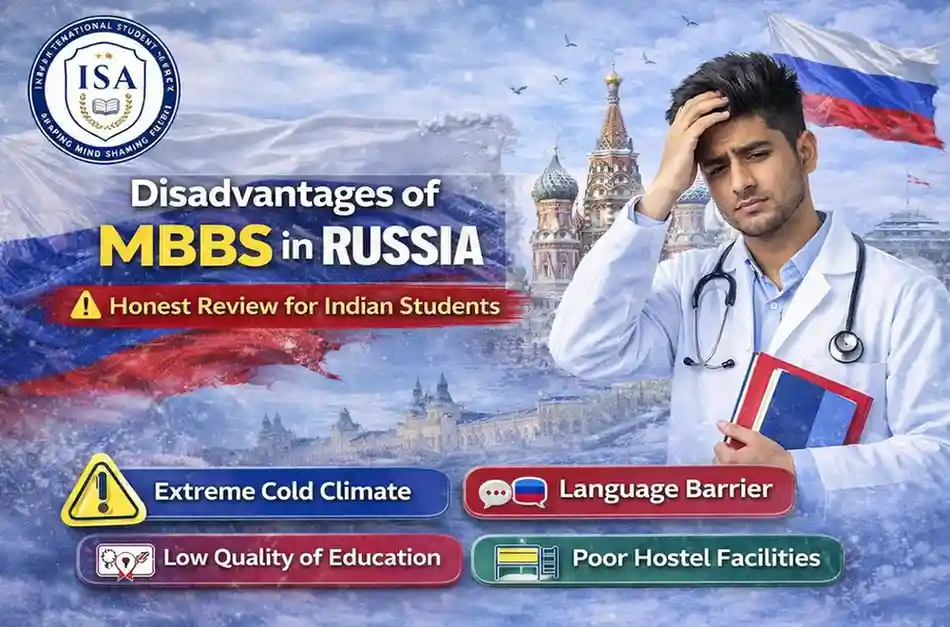
Disadvantages of Studying MBBS in Russia (What Indian Students Must Know)
Russia has emerged as a popular destination for Indian students seeking affordable MBBS education abroad. Low tuition fees, simple admission procedures, and English-medium programs make it attractive.
However, studying MBBS in Russia also comes with several disadvantages that students must clearly understand before taking a decision.
This article covers the real drawbacks of studying MBBS in Russia, based on academic structure, clinical exposure, licensing requirements, lifestyle challenges, and post-MBBS career prospects.
1. Language Barrier During Clinical Practice
Although MBBS courses in Russia are officially taught in English, local hospitals primarily use Uzbek or Russian.
Why this is a problem:
Difficulty communicating with patients
Limited doctor–patient interaction during clinical years
Dependence on translators in hospitals
Impact:
Clinical learning becomes observation-based instead of hands-on, especially in government hospitals.
2. Limited Clinical Exposure Compared to India
One of the biggest disadvantages of MBBS in Russia is lower patient flow in many teaching hospitals.
Key issues:
Fewer real-life cases during early clinical years
Less emergency exposure
Reduced confidence in clinical diagnosis
Indian medical colleges generally offer higher patient volume, which directly improves clinical skills.
3. FMGE / NExT Exam Is Mandatory After MBBS
An MBBS degree from Russia does not allow direct medical practice in India.
Indian students must:
Qualify NExT (earlier FMGE)
Complete compulsory internship as per NMC guidelines
Important reality:
Foreign graduates face low pass rates
Extra coaching and preparation are usually required after returning to India
This adds time, pressure, and cost after graduation.
4. Quality of Medical Universities Is Not Uniform
Not all medical universities in Russia provide the same academic standards.
Risks include:
Outdated curriculum
Limited modern lab facilities
Faculty shortage in some private universities
Critical point:
Choosing the wrong university can severely affect your education and NExT preparation.
5. Cultural, Food, and Climate Adjustment Issues
Russia is culturally very different from India.
Common challenges for Indian students:
Limited Indian food options
Harsh winters in some regions
Conservative social environment
Homesickness and isolation
These factors may seem minor, but they directly affect mental health and academic focus.
6. Limited International Recognition for Practice
An MBBS degree from Russia is:
Valid in India only after NExT
Not automatically accepted in countries like the USA, UK, or Canada
For international practice, students must clear exams such as:
USMLE
PLAB
AMC
This requires additional preparation and expense.
7. No Significant Part-Time Work Opportunities
Unlike countries such as Germany or Australia:
Part-time jobs are rare for international students
Language barriers limit work options
Income support during studies is minimal
Students must be financially prepared before choosing Russia.
8. Heavy Dependence on Admission Agents
Most Indian students go through consultants.
Problems faced:
False promises about facilities and exposure
Incomplete information about universities
Weak post-admission support
Once admitted, students largely manage on their own.
Is MBBS in Russia a Bad Option?
No — but it is not suitable for everyone.
MBBS in Russia is suitable if:
You have a limited budget
You are self-disciplined and academically strong
You are mentally prepared for NExT
You choose an NMC-recognized university carefully
MBBS in Russia is NOT suitable if:
You expect strong clinical exposure from day one
You want an easy medical degree
You struggle with independent study
You are not prepared for licensing exams
Final Verdict: Should You Study MBBS in Russia?
Studying MBBS in Russia can be a cost-effective option, but it comes with clear trade-offs:
Less clinical exposure
Language challenges
Licensing pressure after graduation
There is no shortcut to becoming a doctor. If low fees are your only reason, you may struggle later. If you are focused, disciplined, and choose the right university, Russia can still work.
The decision should be strategic, not emotional.
Get Free Counselling
Choose MBBS in Russia?
👉 Free Application Review – Limited Seats for 2026 Intake
📞 WhatsApp Counselling Available
📄 Document Verification at No Cost
Best wishes for your medical education journey!
Frequently Asked Questions (FAQs) – Disadvantages of Studying MBBS in Russia
The main disadvantages include limited clinical exposure, language barriers during hospital training, mandatory NExT/FMGE exam for India, variation in university quality, and limited global recognition without additional licensing exams.
Yes, MBBS degrees from NMC-recognized universities in Russia are valid in India. However, Indian students must clear the NExT exam and complete the required internship to practice medicine in India.
Academically, no — classes are taught in English.
Clinically, yes — most patients and hospital staff communicate in Uzbek or Russian, which can limit hands-on clinical learning unless students learn the local language.
Clinical exposure in Uzbekistan is generally lower than Indian government medical colleges due to fewer patient inflows. Training is often more observation-based, especially in early clinical years.
Yes. Clearing NExT (earlier FMGE) is compulsory for Indian students to practice medicine in India after completing MBBS in Russia.
No. There is a significant difference in infrastructure, faculty, and hospital facilities among universities. Choosing a poorly ranked or non-experienced university can negatively affect education and exam preparation.
Part-time work opportunities are very limited for international students due to language barriers and local regulations. Students should not rely on part-time income to manage expenses.
An MBBS degree from Russia is not automatically recognized worldwide. Graduates must clear additional exams such as USMLE, PLAB, or AMC depending on the country they wish to practice in.
It is not risky if:
The university is NMC-recognized
The student is academically disciplined
Proper guidance is taken before admission
It becomes risky if decisions are made only based on low fees.
Students who:
Expect strong clinical exposure from day one
Are weak in self-study
Want an “easy” medical degree
Are not prepared for NExT/FMGE
should reconsider this option.
Get Personalized Budget Plan
-
Life of an Indian MBBS Student in Georgia – Real Experience (2026)
Advantages of MBBS in Georgia Honest Review for Indian Students (2026) ... -
Disadvantages of Studying MBBS in Georgia for Indian Students (2026)
Advantages of MBBS in Georgia Honest Review for Indian Students (2026) ... -
Advantages of MBBS in Georgia – Honest Review for Indian Students (2026)
Advantages of MBBS in Georgia Honest Review for Indian Students (2026) ... -
MBBS in Georgia – Is It Worth It for Indian Students? (2026 Guide)
Is Georgia Good for MBBS? Is Georgia Good for MBBS? Honest... -
Is Georgia Good for MBBS? Fees, Safety & NMC Truth (2026)
Is Georgia Good for MBBS? Is Georgia Good for MBBS? Honest... -
MBBS in Uzbekistan Duration 2026: Course Length, Internship & NMC Rules
How Many Years Is an MBBS in Uzbekistan? Complete Course Duration...