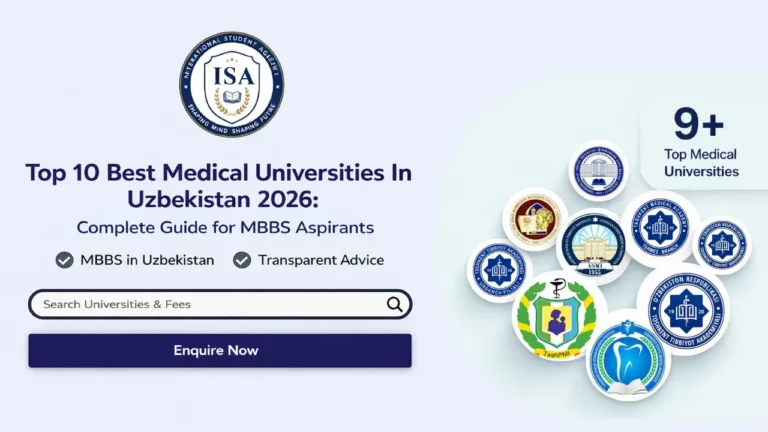
Top 10 Best Medical Universities In Uzbekistan 2026: Complete Guide for MBBS Aspirants
Choosing the right medical university is one of the most crucial decisions in your journey to becoming a doctor. If you’re considering pursuing MBBS abroad, Uzbekistan has emerged as a preferred destination for thousands of international students, particularly from India, Pakistan, Bangladesh, and African nations.
In this comprehensive guide, we’ll walk you through the top 10 medical universities in Uzbekistan for 2026, helping you make an informed decision about your medical education abroad.
Why Choose Uzbekistan for MBBS?
Uzbekistan has rapidly gained recognition as a cost-effective and quality-focused destination for medical education. Here’s what makes it stand out:
Affordable Education
The tuition fees in Uzbekistan are significantly lower compared to private medical colleges in India, the UK, or the USA. Students can complete their entire MBBS degree for a fraction of the cost while receiving quality education that meets international standards.
International Recognition
Medical universities in Uzbekistan are recognized by major international bodies including the World Health Organization (WHO), the National Medical Commission (NMC) of India, and listed in the World Directory of Medical Schools (WDMS). This recognition allows graduates to practice medicine globally after clearing the respective licensing examinations.
English-Medium Programs
Most medical universities in Uzbekistan offer MBBS programs in English, eliminating the language barrier for international students. This makes it easier for students to grasp complex medical concepts and communicate effectively during clinical training.
Modern Infrastructure
Uzbek medical universities have invested heavily in upgrading their infrastructure, laboratories, research facilities, and teaching hospitals. Students get hands-on clinical exposure from the early years of their program.
Safe and Welcoming Environment
Uzbekistan is known for its political stability, low crime rates, and hospitable culture. The country has a significant population familiar with international students, making the transition smoother for newcomers.
MBBS in Uzbekistan Admission Process – Step by Step
Step 1: Choose Your University – Research and select from the best MBBS colleges in Uzbekistan based on rankings, fees, and facilities.
Step 2: Check Eligibility – Ensure you meet the age, educational, and NEET qualification requirements.
Step 3: Submit Application – Fill out the application form and submit required documents including 10th and 12th mark sheets, NEET scorecard, passport copy, and photographs.
Step 4: Receive Offer Letter – Universities review applications and issue an official offer letter within 7-10 days.
Step 5: Pay Initial Fees – Pay the first installment of tuition fees to confirm your seat.
Step 6: Apply for Student Visa – Submit visa application with offer letter, passport, medical certificate, and other documents to the Uzbekistan embassy.
Step 7: Fly to Uzbekistan – After visa approval, book your flight and complete university registration upon arrival.
Best Medical Universities in Uzbekistan 2026
International Student Agency (ISA) is a trusted education consultancy dedicated to helping Indian students pursue MBBS and medical education in Uzbekistan with confidence and clarity.
Tashkent Medical Academy (TMA)
Location: Tashkent, Uzbekistan
Established: 1919
Recognition: WHO, NMC, ECFMG
Tashkent Medical Academy is the oldest and most prestigious medical institution in Uzbekistan. With over 100 years of excellence in medical education, TMA has produced thousands of qualified doctors who serve globally.
Key Highlights:
- Over 7,000 students including 2,500+ international students
- 70+ affiliated teaching hospitals for clinical training
- Advanced research centers and laboratories
- Experienced faculty with international exposure
- Active student exchange programs with European universities
Samarkand State Medical Institute (SamSMI)
Location: Samarkand, Uzbekistan
Established: 1930
Recognition: WHO, NMC
Samarkand State Medical Institute is located in the historic city of Samarkand and is known for its strong emphasis on practical training and research-oriented curriculum.
Key Highlights:
- One of the leading medical institutes in Central Asia
- Well-equipped anatomy and pathology labs
- Modern simulation centers for surgical training
- International faculty members
- Strong focus on community medicine and public health
Andijan State Medical Institute (ASMI)
Location: Andijan, Uzbekistan
Established: 1955
Recognition: WHO, NMC, FAIMER
Andijan State Medical Institute has established itself as a center of excellence in medical education with a focus on innovation and student-centered learning.
Key Highlights:
- Over 5,000 students from 25+ countries
- Digital library with access to international medical journals
- Affordable cost of living in Andijan
- Regular workshops and medical conferences
- Modern hostel facilities with Indian mess options
Bukhara State Medical Institute (BSMI)
Location: Bukhara, Uzbekistan
Established: 1990
Recognition: WHO, NMC
Located in the ancient city of Bukhara, this institute combines traditional values with modern medical education, creating well-rounded medical professionals.
Key Highlights:
- Rapidly growing international student community
- Strong clinical rotation program from 3rd year
- Collaboration with Russian and European medical schools
- Affordable accommodation near campus
- Cultural heritage and safe city environment
Fergana Medical Institute of Public Health
Location: Fergana, Uzbekistan
Established: 1992
Recognition: WHO, NMC
Fergana Medical Institute specializes in public health and preventive medicine while offering comprehensive MBBS training with strong community medicine exposure.
Key Highlights:
- Unique focus on public health and epidemiology
- Low student-to-teacher ratio ensuring personalized attention
- Modern teaching methodologies including case-based learning
- Affordable tuition and living costs
- Easy accessibility and transport facilities
Tashkent Pediatric Medical Institute (TPMI)
Location: Tashkent, Uzbekistan
Established: 1972
Recognition: WHO, NMC
As the name suggests, TPMI has a special focus on pediatrics and child healthcare, though it offers comprehensive general medical education as well.
Key Highlights:
- Specialized training in pediatrics and child health
- State-of-the-art children’s hospital for clinical training
- International pediatric conferences and workshops
- Research opportunities in maternal and child health
- Dedicated international student support services
Urgench Branch of Tashkent Medical Academy
Location: Urgench, Uzbekistan
Established: 2006
Recognition: WHO, NMC
This branch of the prestigious Tashkent Medical Academy brings the same quality of education to the Khorezm region with modern facilities and experienced faculty.
Key Highlights:
- Follows the curriculum of Tashkent Medical Academy
- Smaller city with lower living expenses
- Growing international student population
- Modern campus with updated equipment
- Friendly local community
Termez State University Medical Faculty
Location: Termez, Uzbekistan
Established: 2017 (Medical Faculty)
Recognition: WHO, NMC (in process)
Though relatively new, the medical faculty at Termez State University has quickly gained recognition for its modern approach and infrastructure.
Key Highlights:
- Brand new infrastructure and equipment
- Small class sizes for better learning
- Located near the Afghanistan border, diverse cultural exposure
- Affordable fees and accommodation
- Growing reputation among international students
Nukus Branch of Tashkent Pediatric Medical Institute
Location: Nukus, Karakalpakstan, Uzbekistan
Established: 2019
Recognition: WHO, NMC (in process)
This branch extends quality pediatric medical education to the autonomous region of Karakalpakstan with a focus on serving underserved communities.
Key Highlights:
Focus on rural and community healthcare
Exposure to unique health challenges and tropical diseases
Very affordable cost of living
Close-knit student community
English and Russian medium instruction
Tashkent State Dental Institute
Location: Tashkent, Uzbekistan
Established: 1939
Recognition: WHO, NMC
For students interested in dental medicine, Tashkent State Dental Institute is the premier institution in Uzbekistan offering specialized dental education.
Key Highlights:
- Oldest dental institute in Central Asia
- Advanced dental labs and simulation clinics
- Affiliated dental hospitals for practical training
- International dental conferences and workshops
- High success rate in licensing exams
Complete Admission Process for MBBS in Uzbekistan
Pursuing MBBS in Uzbekistan involves a straightforward admission process. Here’s a step-by-step guide:
Eligibility Criteria
Academic Qualifications:
- Completion of 10+2 or equivalent with Physics, Chemistry, and Biology
- Minimum 50% aggregate marks (45% for SC/ST/OBC candidates as per NMC guidelines)
- English as a compulsory subject in 10+2
For Indian Students:
- NEET qualification is mandatory
- Students must score the minimum qualifying percentile as per NMC norms
Age Criteria:
- Minimum age: 17 years as of December 31st of the admission year
- Maximum age: Generally 25 years (may vary slightly by university)
Required Documents
- Completed application form
- 10th and 12th mark sheets and certificates (attested)
- NEET scorecard and admit card (for Indiastun students)
- Valid passport with minimum 18 months validity
- Birth certificate
- Medical fitness certificate
- HIV test certificate
- Police clearance certificate (PCC)
- Recent passport-size photographs (white background)
- Invitation letter from the university
- Migration certificate (if applicable)
Application Process Timeline
| Step | Stage | Timeline | Key Activities |
|---|---|---|---|
| Step 1 | Research & Selection | March – May | Research universities and rankings, compare fees, facilities, and recognition, consult education counselors if required |
| Step 2 | Application Submission | May – July | Fill out application forms, submit scanned documents, pay application fee (approx. $50–$100) |
| Step 3 | Offer Letter | June – August | Universities review applications, eligible students receive provisional offer letters, confirm acceptance and pay initial deposit |
| Step 4 | Invitation Letter | July – August | University issues official invitation letter required for visa processing |
| Step 5 | Visa Application | August – September | Apply for student visa at Uzbekistan Embassy, submit passport, invitation letter, and documents; processing time: 15–20 working days |
| Step 6 | Travel & Enrollment | September – October | Book flights, airport pickup by university, complete enrollment, medical check-up in Uzbekistan, register with Indian Embassy |
The student visa for Uzbekistan is relatively simple:
- Obtain invitation letter from the university
- Fill out visa application form online
- Submit at Uzbekistan Embassy with required documents
- Pay visa fee (approximately $150-$200)
- Collect visa within 15-20 days
- Entry visa is converted to student residence permit after arrival
Important: Students must register with the local OVIR (visa registration office) within 3 days of arrival in Uzbekistan.
One of the biggest advantages of studying MBBS in Uzbekistan is the affordability factor. Here’s a detailed breakdown:
Tuition Fees
- Annual tuition: $2,500 – $4,500 depending on the university
- Total course fee (6 years): $15,000 – $27,000
- Payment can usually be made in two installments per year
Accommodation
- Hostel fees: $300 – $600 per year
- Private accommodation: $80 – $150 per month
- Most universities provide on-campus hostels with basic amenities
Living Expenses
- Food: $80 – $120 per month (Indian mess available)
- Transportation: $10 – $20 per month
- Books and study materials: $100 – $200 per year
- Miscellaneous expenses: $50 – $80 per month
One-Time Expenses
- Visa fees: $150 – $200
- Medical insurance: $100 – $150 per year
- Flight tickets: $300 – $500 (varies by season)
- Document attestation: $100 – $150
For 6 years of MBBS in Uzbekistan: $25,000 – $40,000 (approximately ₹20-32 lakhs)
This is significantly lower compared to:
- Private medical colleges in India: ₹50 lakhs – ₹1.5 crores
- MBBS in USA: $250,000 – $400,000
- MBBS in UK: £200,000 – £300,000
- MBBS in Australia: AUD 300,000 – 400,000
Academic Environment
The curriculum in Uzbek medical universities follows international standards and is comparable to medical programs in Europe and India. The 6-year program includes:
- Years 1-2: Pre-clinical subjects (Anatomy, Physiology, Biochemistry, Histology)
- Years 3-4: Para-clinical subjects (Pathology, Microbiology, Pharmacology, Forensic Medicine)
- Years 5-6: Clinical rotations (Medicine, Surgery, Pediatrics, Obstetrics & Gynecology)
Teaching Methodology
- Lectures delivered in English by experienced faculty
- Interactive seminars and group discussions
- Practical sessions in well-equipped laboratories
- Clinical rotations in affiliated hospitals from 3rd year
- Case-based learning and problem-solving approaches
- Regular assessments and examinations
Campus Life
- Safe and secure campus environment
- 24/7 security with CCTV surveillance
- Student clubs and cultural activities
- Sports facilities including cricket, football, and basketball
- Libraries with extensive medical literature
- Internet and Wi-Fi facilities in hostels
Food and Accommodation
- University hostels with 2-3 students per room
- Separate hostels for boys and girls
- Indian mess serving vegetarian and non-vegetarian food
- Local Uzbek cuisine also available
- Kitchen facilities in some hostels
- Nearby supermarkets for groceries
Cultural Adaptation
Uzbekistan has a mixed culture with influences from Soviet, Islamic, and modern Western traditions. The people are generally friendly towards international students, and you’ll find:
- English-speaking locals in major cities
- Indian restaurants and grocery stores
- Active Indian student associations
- Cultural festivals and celebrations
- Religious freedom with mosques, temples, and churches available
Career Opportunities After MBBS from Uzbekistan
Graduating with an MBBS degree from Uzbekistan opens up numerous career pathways globally. Here’s what you need to know:
For Indian Students
FMGE/NExT Examination: To practice medicine in India, graduates from foreign medical universities must clear the Foreign Medical Graduates Examination (FMGE), which is being replaced by the National Exit Test (NExT).
- Exam conducting body: National Board of Examinations (NBE)
- Exam pattern: Computer-based test with 300 multiple-choice questions
- Passing criteria: Minimum 50th percentile
- Frequency: Twice a year (June and December)
Many Uzbekistan medical graduates successfully clear this exam with proper preparation and go on to practice in India.
Statistics: The passing rate for FMGE has improved over the years, with graduates from recognized universities in Uzbekistan showing competitive performance.
International Licensing Exams
USMLE (United States Medical Licensing Examination): For students aspiring to practice in the USA, they need to clear:
- USMLE Step 1: Basic medical sciences
- USMLE Step 2 CK: Clinical knowledge
- USMLE Step 2 CS: Clinical skills
- USMLE Step 3: Final assessment
Uzbekistan medical graduates are eligible to appear for USMLE after completing their degree.
PLAB (Professional and Linguistic Assessments Board): For practicing in the UK:
- PLAB Part 1: Written examination
- PLAB Part 2: Practical assessment (OSCE)
Uzbekistan MBBS graduates can register with the General Medical Council (GMC) after clearing PLAB.
Other Countries:
- Australia: Australian Medical Council (AMC) examination
- Canada: Medical Council of Canada Evaluating Examination (MCCEE)
- Middle East: Most Gulf countries accept MBBS from Uzbekistan with country-specific licensing
Postgraduate Opportunities
After completing MBBS, students can pursue:
- MD/MS in India: After clearing NEET-PG
- Residency programs abroad: In USA, UK, Canada, Australia
- Research opportunities: In medical universities and research institutes
- Public health programs: MPH from international universities
Job Prospects
MBBS graduates from Uzbekistan work in various capacities:
- Practicing doctors in hospitals and clinics
- Medical officers in government and private sectors
- Healthcare consultants and advisors
- Medical researchers and academicians
- Public health specialists
- Medical entrepreneurs (clinic owners, diagnostic centers)
Salary Range in India (after FMGE):
- Starting salary: ₹3-6 lakhs per annum
- With experience (5+ years): ₹8-15 lakhs per annum
- Specialist doctors: ₹15-50 lakhs per annum
Advantages of Studying MBBS in Uzbekistan
1. Cost-Effective Education
The most significant advantage is affordability without compromising on quality. Students save lakhs of rupees compared to private medical colleges in India.
2. No Donation or Capitation Fees
Unlike many private medical colleges, Uzbek universities have transparent fee structures with no hidden costs or donations.
3. International Exposure
Studying with students from various countries provides cultural diversity and global networking opportunities.
4. Recognized Degrees
WHO and NMC recognition ensures that your degree is valid globally, allowing you to practice medicine anywhere after clearing the respective licensing exams.
5. Quality Education
Well-structured curriculum, experienced faculty, and modern teaching facilities ensure quality medical education.
6. Clinical Training
Extensive hands-on clinical experience in affiliated hospitals prepares students for real-world medical practice.
7. Safe Environment
Uzbekistan is politically stable with low crime rates, making it a safe destination for international students.
8. No Language Barrier
English-medium instruction eliminates language-related learning difficulties.
Challenges and How to Overcome Them
While studying MBBS in Uzbekistan has numerous advantages, students should be aware of potential challenges:
1. Climate Adjustment
Challenge: Extreme winters can be harsh for students from tropical countries. Solution: Invest in good winter clothing, use room heaters, and stay indoors during extreme weather.
2. Food Adjustment
Challenge: Uzbek cuisine is different from Indian food. Solution: Most universities have Indian mess facilities. You can also cook in hostel kitchens. Indian grocery stores are available in major cities.
3. Homesickness
Challenge: Being away from family and friends can be emotionally challenging. Solution: Stay connected through video calls, join Indian student associations, make friends, and visit home during vacations.
4. Language Barrier Outside Campus
Challenge: Local language (Uzbek/Russian) is spoken outside university premises. Solution: Learn basic Uzbek or Russian phrases. Most shopkeepers in student areas understand English or have translation apps.
5. FMGE/NExT Preparation
Challenge: Clearing the licensing exam after returning to India requires dedicated preparation. Solution: Start preparation from the 3rd or 4th year. Join online coaching, practice previous years’ papers, and take mock tests regularly.
Before Admission
- Research thoroughly about universities and verify their NMC recognition
- Connect with current students or alumni for honest reviews
- Compare fees, facilities, and success rates in licensing exams
- Consult authorized education consultants for guidance
- Prepare all documents in advance to avoid last-minute hassles
During Your Studies
- Focus on understanding concepts rather than rote learning
- Participate actively in clinical rotations and practical sessions
- Maintain good attendance and academic records
- Start FMGE/NExT preparation from the 3rd year
- Learn local language basics for better integration
- Stay connected with the Indian Embassy for any assistance
- Manage your finances wisely
- Build a network of friends and mentors
- Participate in extracurricular activities for holistic development
- Take care of your physical and mental health
After Graduation
- Register with NMC immediately after returning
- Dedicate 4-6 months for intensive FMGE/NExT preparation
- Consider joining coaching institutes with good track records
- Practice with mock tests and previous years’ question papers
- Stay updated with medical advancements and research
- Network with medical professionals for career guidance
MBBS in Uzbekistan vs Other Countries – Comparison
Uzbekistan vs Russia
Uzbekistan: Warmer climate, lower cost, safer currently, easier visa process, strong Indian community
Russia: Higher fees, colder climate, recent geopolitical concerns, longer visa processing
Uzbekistan vs Kazakhstan
Uzbekistan: More affordable, better climate, established medical education system, easier admission
Kazakhstan: Slightly higher fees, similar quality, harsher winters, comparable infrastructure
Uzbekistan vs China
Uzbekistan: Much more affordable, no language barrier, easier cultural adaptation, NMC-approved
China: Higher fees, stricter admission, language challenges, affected by recent policy changes
Uzbekistan vs Philippines
Uzbekistan: More affordable, better infrastructure, safer environment, easier visa
Philippines: Higher cost, tropical climate, longer travel distance, language advantage
Uzbekistan vs Georgia
Uzbekistan: Lower fees, larger Indian community, established reputation, better value for money
Georgia: Similar quality, slightly higher cost, European proximity, comparable advantages
Scholarships for Indian Students Studying MBBS in Uzbekistan
While full scholarships are rare, several options exist to reduce financial burden:
Merit-Based Scholarships: Top-scoring students may receive 10-25% fee waivers based on 12th marks and NEET scores.
Early Bird Discounts: Many universities offer discounts for students who apply and pay fees early in the admission cycle.
Group Discounts: Students applying together from the same region may get special fee concessions.
Sibling Discounts: Some universities offer reduced fees if siblings study in the same institution.
Financial Aid: Need-based assistance for students from economically weaker sections.
Government Scholarships: Uzbekistan government occasionally offers bilateral exchange scholarships.
Students should inquire directly with universities or authorized representatives about available scholarship opportunities and eligibility criteria.
Get Free Counselling
Choose MBBS in Uzbekistan.
Studying MBBS in Uzbekistan can be a life-changing decision that sets you on the path to fulfilling your dream of becoming a doctor. With proper research, preparation, and commitment, you can successfully complete your medical education and build a rewarding career in healthcare.
If you have specific questions about any university or need help with the admission process, feel free to reach out to authorised education consultants who specialise in MBBS admissions abroad. They can provide personalised guidance based on your academic profile and career goals.
Pursuing MBBS in Uzbekistan presents an excellent opportunity for students who aspire to become doctors but face challenges with high fees or limited seats in their home countries. The combination of affordable education, international recognition, quality infrastructure, and a safe environment makes Uzbekistan an attractive destination for medical studies.
The universities listed in this guide have established reputations, proper recognition, and track records of producing successful medical graduates. Whether you choose the prestigious Tashkent Medical Academy or opt for a newer institution like Termez State University, the key to success lies in your dedication, hard work, and commitment to the medical profession.
Disclaimer: The information provided in this blog is based on publicly available data as of 2026. Fees, admission criteria, and university policies may change. Always verify the latest information from official university websites or authorised representatives before making your decision.
Becoming a doctor begins here – make the right choice, choose Uzbekistan!
👉 Free Application Review – Limited Seats for 2026 Intake
📞 WhatsApp Counselling Available
📄 Document Verification at No Cost
Best wishes for your medical education journey!
Have questions about the admission process? Drop them in the comments below. We try to respond within 24 hours.
Found this guide helpful? Share it with other students planning to study MBBS in Uzbekistan. Knowledge shared is knowledge multiplied.
Frequently Asked Questions (FAQs)
Yes, MBBS degrees from NMC-recognized universities in Uzbekistan are valid in India. Graduates must clear the FMGE/NExT examination to practice in India.
The medium of instruction is English in all major medical universities offering programs for international students.
Yes, NEET qualification is mandatory for Indian students as per NMC guidelines. The minimum qualifying percentile is required.
Uzbekistan is considered one of the safest Central Asian countries with low crime rates and political stability. Universities also provide 24/7 security on campus.
Yes, after clearing the respective country's licensing examination (FMGE for India, USMLE for USA, PLAB for UK), you can practice medicine globally.
The MBBS program in Uzbekistan is 6 years, including a one-year internship.
Apart from NEET (for Indian students), most universities do not conduct additional entrance exams. Admission is based on your 10+2 marks and NEET score.
The monthly living expenses range from $150-$250, including food, accommodation, transportation, and personal expenses.
Yes, most universities provide on-campus hostel accommodation. Private accommodation is also available near campus.
Student visas generally don't permit full-time employment. However, some universities offer research assistant positions or internship opportunities.
Get Personalized Budget Plan
-

Government vs Private MBBS Fees in Kyrgyzstan – Detailed Comparison
Government vs Private College Fees Government vs Private College Fees Blogs ... -
Year-Wise MBBS Fee Structure in Kyrgyzstan (2026 Guide)
Year-Wise MBBS Fee Structure in Kyrgyzstan (2026 Guide) Blogs About Us Year-wise... -
MBBS Fees in Kyrgyzstan 2026 – Total Cost & Fees in Rupees
Does NMC Recognize Georgian Medical Universities? Complete Truth for Indian Students... -
Does NMC Recognize Georgian Medical Universities? Complete Truth (2026)
Does NMC Recognize Georgian Medical Universities? Complete Truth for Indian Students... -
How to Check NMC Compliance of Georgian Medical Universities (2026 Guide)
Will My MBBS Degree from Abroad Be Valid in India? (2026... -
NMC Rules for MBBS in Georgia 2026 | FMGLR 2021 Explained in Detail
Will My MBBS Degree from Abroad Be Valid in India? (2026...