Is NEET Required In Tbilisi State Medical University? (Complete Answer for Indian Students 2026)
Tbilisi State Medical University (TSMU) is one of the most prestigious and oldest medical universities in Georgia—and one of the top choices for Indian students pursuing MBBS abroad. It’s affordable, internationally recognized, and offers quality medical education in English.
But if you’re an Indian student researching TSMU, one question is probably at the top of your mind:
“Is NEET required for admission to Tbilisi State Medical University?“
It’s a critical question. The answer affects whether you can even apply, whether your degree will be valid back in India, and whether you’re making a safe investment of your time and money.
Here’s why this question confuses so many students: you’ll hear different answers depending on who you ask. Some consultants say “NEET is mandatory.” Others say “TSMU accepts students without NEET.” Some say “it depends.” And if you’re a parent trying to help your child navigate this, the conflicting information can be maddening.
So let me give you the complete, honest answer—no marketing fluff, no hidden agendas. In this guide, you’ll learn:
- Whether TSMU requires NEET for admission (university policy)
- What the NMC (National Medical Commission) requires for Indian students (Indian government policy)
- The critical difference between admission and practice rights
- What documents TSMU actually asks for during application
- Real consequences of studying at TSMU without NEET
- The safest, smartest path for Indian students
By the end of this article, you’ll have absolute clarity on NEET requirements for TSMU and know exactly what you need to do.
Let’s start with the direct answer.
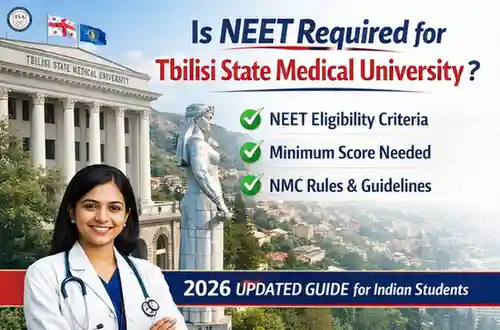
The Direct Answer: Is NEET Required for TSMU?
Here’s the truth in one clear statement:
Tbilisi State Medical University does not technically require NEET for admission—but the National Medical Commission (NMC) of India requires all Indian students to have qualified NEET to practice medicine in India, regardless of where they study.
Let me break this down because understanding this difference is absolutely critical.
Two Different Requirements, Two Different Authorities
What TSMU (the university) requires:
- Class 12 pass certificate with Physics, Chemistry, Biology
- Minimum 50% aggregate in PCB (some sources say 60%)
- Valid passport
- Age: 17 years minimum on or before December 31st of admission year
- Tuition fee payment
What the NMC (India’s medical regulator) requires:
- NEET qualification certificate
- NEET score from the year of admission or previous year
- This is mandatory for your degree to be recognized in India
- This is mandatory to appear for FMGE/NExT (licensing exam)
What Georgian Universities Actually Require
Here’s where it gets interesting.
Most Georgian medical universities don’t set a minimum NEET score for admission. Their official requirement is simply:
✓ You must have qualified NEET (i.e., scored above the percentile cutoff)
That’s it. Whether you scored in the 50th percentile or the 99th percentile usually doesn’t matter to them.
Their admission criteria typically include:
- Valid NEET qualification certificate
- Minimum 50% aggregate in Physics, Chemistry, Biology in Class 12 (40% for reserved categories)
- Age: 17 years minimum, usually no upper age limit
- Valid passport
- Ability to pay tuition fees
So in practical terms: If you’ve qualified NEET, most Georgian universities will accept you regardless of your exact score.
Why This Matters
This is actually great news if you’re in this situation:
- You qualified NEET but didn’t get a good rank
- You can’t afford private medical colleges in India (₹50 lakhs–₹1.5 crore)
- Government college seats are out of reach with your rank
- You want to become a doctor without compromising your family’s finances
Georgia becomes a viable, affordable option. You’re not competing for seats based on rank—you just need to have cleared the cutoff.
What This Means in Practice
Think of it this way:
TSMU will admit you → even without NEET (based on their admission criteria)
NMC will NOT register you → without NEET (based on Indian regulations)
So technically, you can get admission at TSMU without NEET. You can study there. You can graduate with an MBBS degree.
But when you return to India:
- You cannot register with the NMC
- You cannot get a medical license
- You cannot practice medicine legally
- You cannot work in any hospital
- Your degree becomes useless in India
Bottom line: You need NEET—not for TSMU admission, but for your medical career in India.
Understanding TSMU's Admission Requirements
Let me explain exactly what Tbilisi State Medical University asks for when Indian students apply.
Official TSMU Admission Criteria
According to TSMU’s international admissions office, here’s what they require from Indian applicants:
Academic Requirements:
- Class 12 completion with Physics, Chemistry, Biology as main subjects
- Minimum aggregate: 50-60% in PCB (the exact percentage can vary; verify current requirements)
- English proficiency: Since the program is in English, you should be comfortable with the language (no formal IELTS/TOEFL required usually)
Documentation Required:
- Completed application form
- Class 10th mark sheet and certificate
- Class 12th mark sheet and certificate
- Birth certificate
- Passport (valid for at least 2 years)
- Passport-size photographs (recent, white background)
- Medical fitness certificate
- HIV test report (negative)
- NEET scorecard (for Indian students—more on this below)
Financial Requirements:
- Proof of funds for tuition fees (approximately $6,000-$7,000 per year)
- Proof of funds for living expenses (approximately $200-$300 per month)
Does TSMU Explicitly Ask for NEET?
This is where it gets nuanced.
Official university stance: TSMU’s admission criteria are based on Georgian education standards. They don’t have “NEET” as a mandatory checkbox in their own admission process.
Reality for Indian students: TSMU is well aware that Indian students need NEET to practice back home. So while it’s not formally listed as a mandatory requirement in their Georgian admission policy, they typically ask Indian applicants to submit their NEET scorecard as part of the documentation.
Why? Because:
- It verifies you meet NMC requirements
- It protects the university’s reputation (they don’t want graduates who can’t practice)
- It’s become standard practice for all NMC-recognized Georgian universities
What TSMU Actually Checks
When you apply to TSMU as an Indian student, here’s what they verify:
They DO check:
- Your Class 12 marks in PCB
- Authenticity of your academic documents
- Passport validity
- Medical fitness
- Ability to pay fees
They DON’T really care about:
- Your NEET rank or exact score
- Your NEET percentile beyond basic qualification
- Whether you scored 150 or 650 in NEET
They WILL ask for:
- Your NEET scorecard/admit card (as proof you’ve qualified)
- Confirmation that you meet NMC eligibility requirements
The Confusion Around "NEET Not Required"
Some consultants and websites claim “NEET not required for TSMU.” Here’s what they actually mean:
What they say: “NEET not required for TSMU admission”
What they mean: “TSMU’s own admission policy doesn’t mandate NEET as an entrance exam; they have their own criteria”
What they’re hiding: “But you absolutely need NEET to practice in India, so don’t go without it”
This is technically accurate but dangerously misleading. It’s like saying “you don’t need a driver’s license to buy a car.” True—but you can’t legally drive it without the license.
Get Free Counselling
Choose MBBS in Georgia?
What the NMC (National Medical Commission) Actually Requires
Now let’s talk about the authority that really matters for your medical career in India: the National Medical Commission.
The NMC’s Non-Negotiable Rule
The NMC’s regulation is crystal clear:
Any Indian citizen or OCI (Overseas Citizen of India) pursuing MBBS abroad must have qualified NEET in order for their foreign medical degree to be recognized for practice in India.
This applies to all foreign medical universities, including TSMU.
Why the NMC Requires NEET
The NMC’s reasoning is straightforward:
- Quality control: NEET ensures students have a minimum level of competence in basic sciences before entering medical school
- Standardization: One uniform standard for all Indian medical students, whether studying in India or abroad
- Preventing exploitation: Stops unqualified students from buying degrees abroad and practicing in India
- Public safety: Ensures doctors treating Indian patients meet baseline qualifications
What "Qualifying NEET" Actually Means
You need to score at or above the NMC’s percentile cutoff:
- General/EWS category: 50th percentile or above
- SC/ST/OBC category: 40th percentile or above
- PwD category: 45th percentile or above (if applicable)
In terms of actual marks (out of 720), this typically translates to approximately:
- General: 140-150+ marks (varies yearly)
- Reserved categories: 125-135+ marks (varies yearly)
Important: Your exact NEET score or rank doesn’t matter. You just need to have qualified (crossed the percentile cutoff). Whether you scored 150 or 700, both are treated equally by the NMC for eligibility purposes.
The NEET Timeline Requirement
The NMC also specifies when you must have qualified NEET:
Your NEET qualification must be from the year of your admission or the immediately preceding year.
Example:
- If you’re joining TSMU in September 2026, you need NEET 2026 or NEET 2025
- A NEET score from 2023 or 2024 won’t be valid
- If your old NEET has expired, you must reappear and qualify fresh
NEET Is Required for FMGE/NExT
Even if you somehow complete MBBS at TSMU without NEET, here’s what happens when you return to India:
To practice medicine in India, you must:
- Pass FMGE (Foreign Medical Graduate Examination) or NExT (National Exit Test)—this is the screening/licensing exam
- Complete internship (if required)
- Register with NMC and get your medical license
But here’s the catch:
You cannot even appear for FMGE/NExT without a valid NEET qualification certificate.
The NMC will ask for:
- Your NEET scorecard
- Proof that you qualified NEET in the year of admission or previous year
- Your TSMU degree and transcripts
- Proof of completion of MBBS program
No NEET = No FMGE/NExT = No license = No medical practice in India
Your TSMU degree becomes a ₹30-35 lakh wall decoration.
Recent NMC Updates (2025-2026)
The NMC has been tightening enforcement:
Key changes:
- Stricter verification: NMC now cross-checks NEET scorecards more carefully with the National Testing Agency (NTA) database
- No exceptions: Previous loopholes for students who went abroad without NEET have been closed
- NExT transition: FMGE is being replaced by NExT, but NEET requirement remains unchanged
- Physical attendance verification: NMC now checks that students actually attended classes in person, not online programs
What this means for you:
- Don’t believe anyone who says “there are ways around NEET”
- Don’t trust consultants who promise “we’ll handle NMC registration without NEET”
- Don’t assume rules will relax in the future—they’re getting stricter
The Critical Difference: Admission vs. Practice Rights
The Critical Difference: Admission vs. Practice Rights
This is the single most important concept to understand. Most students who get into trouble do so because they confuse these two things.
Admission to TSMU (What the University Controls)
TSMU can admit you based on:
- Their own academic criteria
- Georgian education ministry standards
- University policies
- Internal admission procedures
TSMU’s authority: They decide who studies at their institution.
TSMU’s limitation: They cannot guarantee your degree will be recognized in any specific country.
Right to Practice in India (What the NMC Controls)
NMC controls:
- Which foreign universities’ degrees are recognized in India
- What eligibility criteria Indian students must meet
- Who can appear for FMGE/NExT
- Who gets registered as a medical practitioner
- Who can legally practice medicine in India
NMC's authority: They decide who practices medicine in India.
NMC’s power: They can reject your TSMU degree for registration if you don’t meet their requirements—regardless of what TSMU says.
A Simple Analogy
Think of it like this:
TSMU = A hotel
- They decide whether to give you a room
- Their requirement: Can you pay for the room?
NMC = Immigration at the airport
- They decide whether you can enter India as a doctor
- Their requirement: Do you have the right visa (NEET)?
You can book and stay at the hotel (TSMU) without the visa (NEET). But when you try to enter the country (practice in India), immigration (NMC) will stop you.
What Happens in Practice
Let me show you two real scenarios:
Scenario A: Student WITH NEET
- Qualifies NEET in 2026 (scores 145/720, which is above cutoff)
- Applies to TSMU, gets admission
- Studies MBBS for 5.5 years
- Graduates with MBBS degree
- Returns to India, applies for FMGE/NExT
- Passes FMGE/NExT
- Registers with NMC
- Gets medical license
- Starts working as a doctor ✓
Scenario B: Student WITHOUT NEET
- Applies to TSMU directly (no NEET)
- Gets admission (TSMU accepts based on Class 12 marks)
- Studies MBBS for 5.5 years (₹30-35 lakhs spent)
- Graduates with MBBS degree
- Returns to India, tries to apply for FMGE/NExT
- NMC asks for NEET scorecard
- Student cannot provide it
- FMGE/NExT application rejected ✗
- Cannot register with NMC ✗
- Cannot practice medicine in India ✗
- Only options: (a) Qualify NEET now after 6 years, or (b) Try to work abroad, or (c) Career change
The Hidden Cost of Confusion
Students in Scenario B face:
- Financial loss: ₹30-35 lakhs spent on TSMU fees + living expenses
- Time loss: 5-6 years of their life
- Opportunity cost: Friends who took NEET are already practicing doctors
- Emotional trauma: Watching their medical dreams collapse
- Family stress: Explaining to parents that the degree is unusable
- Uncertain future: Having to decide whether to attempt NEET at age 24-25
All of this could have been avoided by qualifying NEET before going to TSMU.
Real Risks of Studying at TSMU Without NEET
Let me be very direct about what can go wrong if you enroll at TSMU without qualifying NEET.
Risk #1: Degree Not Recognized in India
The biggest risk: Your MBBS degree from TSMU will not be recognized by the NMC.
- You cannot register as a medical practitioner
- You cannot work in any Indian hospital (government or private)
- You cannot open your own clinic
- You cannot pursue MD/MS (post-graduation) in India
- Your degree is legally worthless for medical practice in India
Reality check: TSMU is an excellent university. Their education quality is good. But if the NMC won’t recognize your degree because you lack NEET, the quality of education becomes irrelevant.
Risk #2: Cannot Appear for FMGE/NExT
The licensing barrier: FMGE/NExT is mandatory for all foreign medical graduates to practice in India.
The requirement: You must have qualified NEET to even sit for this exam.
What happens without NEET:
- Your FMGE/NExT application will be rejected at the document verification stage
- There’s no appeal process for missing NEET
- No amount of explanation will help (“I didn’t know,” “my consultant said it’s fine,” etc.)
- The rule is absolute
Risk #3: Financial Loss
The money you’ll lose:
Direct costs:
- TSMU tuition: $6,000-$7,000 × 5-6 years = ₹25-30 lakhs
- Living expenses: $200-$300/month × 66 months = ₹10-12 lakhs
- Travel, books, miscellaneous: ₹2-3 lakhs
- Total: ₹37-45 lakhs
Opportunity costs:
- Income you could have earned in those 5-6 years if you’d chosen a different career
- Interest on education loans (if applicable)
- Money spent on trying to qualify NEET later + coaching fees
All of this becomes a sunk cost if you can’t practice in India.
Risk #4: Time and Age Penalty
The time you’ll lose:
- 5-6 years completing MBBS at TSMU
- If you then have to attempt NEET: 6 months to 2 years of preparation
- If you clear NEET late: delays in FMGE/NExT preparation
- Multiple FMGE/NExT attempts if you don’t pass first time
Age implications:
- You’ll be 24-25 before you can even attempt FMGE/NExT (if you go back and qualify NEET)
- Your batchmates who took NEET will already be established doctors
- Post-graduation seats have age limits—you might miss them
- Marriage/family planning gets delayed
- Career momentum lost
Risk #5: Visa and Immigration Issues
Potential complications:
During studies:
- Some students face questions at Indian immigration when returning home for holidays
- Visa officers may ask about NEET status
- Issues with student visa renewals if Georgian authorities verify NMC compliance
After graduation:
- Difficulty getting work permits in other countries (they verify if you can practice in your home country)
- Complications if you try to pursue residency programs abroad
- Questions about why you have a medical degree but no license
Risk #6: Limited Career Options
What you CAN’T do without NMC registration:
- Practice clinical medicine in India
- Work as a doctor in Indian hospitals
- Open a clinic or nursing home
- Pursue MD/MS in India
- Apply for government medical jobs
- Work in private corporate hospitals
- Join Indian Armed Forces Medical Corps
What you MIGHT be able to do (but it's difficult):
- Try to work in countries that don’t require NMC registration (limited options, language barriers, difficult immigration)
- Work in non-clinical roles (medical writing, pharma, medical coding)—but these don’t require an MBBS degree
- Teaching/research positions (very limited, usually require PhD)
Reality: Most students who go to TSMU do so because they want to practice medicine in India. Without NEET, that door is closed.
Risk #7: Psychological and Emotional Impact
The mental health toll:
- Stress of realizing your degree might be useless
- Anxiety about wasted years and money
- Depression from watching peers succeed while you’re stuck
- Family conflicts and blame
- Identity crisis (“Am I a doctor or not?”)
- Regret and “what if” thoughts
- Pressure to find alternative careers you’re not interested in
This is real: I’ve seen students and parents go through this, and it’s heartbreaking.
Risk #8: Consultant Accountability Issues
The blame game:
If you go to TSMU without NEET based on a consultant’s advice and then face problems:
The consultant will say:
- “We told you verbally about NEET” (no written proof)
- “It was your responsibility to check NMC rules”
- “We only handle admission, not NMC registration”
- “Our job was to get you into TSMU, which we did”
Reality:
- Consultants have no legal liability for your NMC registration
- Their contracts usually have disclaimers
- By the time you realize the problem, they’ve moved on to new students
- Legal action against consultants is expensive and rarely successful
Lesson: Don’t rely on consultants for legal compliance. Verify NMC rules yourself.
The Safe Path: How to Join TSMU the Right Way
Now let me show you the correct, safe, and legal way to study at Tbilisi State Medical University and ensure your degree is recognized in India.
Step 1: Qualify NEET First
This is non-negotiable.
What you need to do:
- Register for NEET (usually January-February)
- Prepare seriously for the exam (or continue if already preparing)
- Appear for NEET (usually held in May)
- Score at least the qualifying percentile for your category
- Download your NEET scorecard and rank letter
What “qualifying” means:
- General/EWS: 50th percentile or above (typically 140-150+ marks)
- SC/ST/OBC: 40th percentile or above (typically 125-135+ marks)
Don’t worry about getting a high rank. For TSMU and NMC eligibility, you just need to qualify. Whether you score 150 or 650, both work equally well for studying at TSMU and practicing in India.
Step 2: Verify TSMU’s NMC Recognition Status
Before applying, confirm:
- Visit the official NMC website
- Download the list of recognized foreign medical institutions
- Verify TSMU is on the list for Georgia
- Check that the recognition is current (not withdrawn or suspended)
As of 2026, TSMU is NMC-recognized, but always verify yourself because:
- Recognition statuses can change
- NMC updates the list periodically
- You want current, not outdated information
TSMU details for verification:
- Full name: Tbilisi State Medical University
- Location: Tbilisi, Georgia
- Established: 1918 (one of the oldest medical universities in Georgia)
- Recognition: Listed in NMC’s recognized foreign universities
Step 3: Prepare Required Documents
Gather everything you’ll need for the TSMU application:
Academic documents:
- Class 10th mark sheet and certificate (original + attested copies)
- Class 12th mark sheet and certificate (original + attested copies)
- NEET scorecard (original + copies)
- NEET admit card (original + copies)
- Migration certificate (if applicable)
- Transfer certificate from previous institution
Personal documents: 7. Birth certificate (original + attested copies) 8. Passport (valid for at least 2 years) 9. Passport-size photographs (10-15 recent white background photos) 10. Aadhar card copy
Medical documents: 11. Medical fitness certificate from a registered doctor 12. HIV test report (negative) from an authorized lab 13. COVID-19 vaccination certificate (check current requirements)
Financial documents: 14. Bank statements showing proof of funds for tuition 15. Income proof of parents/sponsor 16. Loan sanction letter (if taking education loan)
Get documents attested:
- Educational certificates: Attested by MEA (Ministry of External Affairs) and Georgian Embassy
- Medical certificates: Attested by registered medical practitioner
- Follow TSMU’s specific requirements for attestation
Step 4: Apply to TSMU
You have two options:
Option A: Direct Application (Recommended)
- Visit TSMU’s official website (www.tsmu.edu)
- Go to “International Students” or “Admissions” section
- Fill out the online application form
- Upload required documents
- Pay application fee (if any)
- Submit application
- Follow up via email with admissions office
Benefits of direct application:
- No middleman commission
- Direct communication with university
- Complete control over your application
- Saves money
Option B: Through Verified Educational Consultants
- Research consultants with proven TSMU placement records
- Check reviews and testimonials
- Verify they’re authorized by TSMU (ask for documentation)
- Understand all fees upfront (should be reasonable—₹50,000 to ₹1,00,000 max for genuine services)
- Get everything in writing
- Never pay 100% upfront
Benefits of using consultants:
- Hand-holding through the process
- Help with documentation and attestation
- Assistance with visa application
- Airport pickup and initial settling-in support
Warning signs of bad consultants:
- Promise “guaranteed admission” without seeing your documents
- Say “NEET not required” without explaining NMC implications
- Charge excessive fees (₹2-3 lakhs+ for just application services)
- Pressure you to decide quickly
- Don’t provide written agreements
- Can’t show previous successful placements
Step 5: Receive Admission Letter
Once TSMU reviews your application:
- You’ll receive a provisional admission letter (if accepted)
- This letter will include:
- Confirmation of your admission
- Course details (MBBS program, English medium)
- Academic year and start date
- Tuition fee amount
- Hostel/accommodation options
- Instructions for next steps
Verify the letter carefully:
- Is it on official TSMU letterhead?
- Does it have proper signatures and stamps?
- Are fees clearly mentioned?
- Is the start date reasonable?
Red flags:
- Letter looks unofficial or is just an email
- Fees seem too low or too high compared to TSMU’s standard rates
- No mention of specific documents you submitted
- Spelling errors or unprofessional formatting
Step 6: Pay Tuition Fees
Payment process:
- TSMU will provide official payment instructions
- Payment usually goes directly to the university’s bank account
- Never pay to consultants’ personal accounts (this is a major red flag)
- Make payment via:
- Bank wire transfer (most common)
- Demand draft
- Online transfer (if university accepts)
What to pay:
- First-year tuition fee (approximately $6,000-$7,000)
- Hostel/accommodation fee (if applicable)
- Registration/admission fee (one-time)
Do NOT pay for:
- “Donation” or “capitation fees” (TSMU doesn’t charge these)
- Consultant commissions disguised as university fees
- Inflated fees that don’t match TSMU’s official fee structure
Keep proof:
- Bank transfer receipts
- Payment confirmation from TSMU
- Email confirmations
- All documentation of money sent
Step 7: Apply for Student Visa
Georgian student visa process for Indians:
- Get invitation letter from TSMU (official document for visa application)
- Prepare visa documents:
- Passport (valid for at least 6 months beyond travel date)
- Visa application form (filled completely)
- TSMU admission letter
- TSMU invitation letter
- Proof of financial means
- Passport-size photos
- Travel insurance
- Police clearance certificate
- Medical fitness certificate
- Flight booking (tentative)
- Submit visa application:
- Apply at Georgian Embassy/Consulate in India (New Delhi)
- Or apply for e-Visa (check current Georgia visa policies)
- Pay visa fee
- Submit biometrics if required
- Wait for processing: Usually 7-15 working days
- Receive visa: Check all details are correct
Pro tip: Many consultants help with visa applications as part of their service. This can be valuable if you’re unfamiliar with the process.
Step 8: Travel to Georgia and Join TSMU
Pre-departure:
- Book flights (September/October for academic session starting September)
- Arrange airport pickup (through TSMU or consultant)
- Pack essentials:
- All original documents (carry in hand luggage)
- Sufficient warm clothing (Georgia has cold winters)
- Indian food items (for initial comfort)
- Medicines, books, electronics
- Inform family, get foreign exchange, activate international roaming
Upon arrival in Tbilisi:
- Airport pickup arranged—don’t take random taxis
- Check into university hostel or arranged accommodation
- Complete university registration within first week
- Attend orientation program
- Get student ID card
- Open local bank account (helpful for living expenses)
- Get local SIM card
- Register with Indian Embassy in Georgia (important for emergencies)
First month priorities:
- Settle into accommodation
- Understand campus layout and facilities
- Attend all orientation sessions
- Make friends with seniors (they’ll guide you)
- Start classes seriously from day one
- Join Indian students’ association at TSMU
- Understand exam patterns and study requirements
Step 9: Study Seriously for 5-6 Years
This is where the real work begins:
Academic commitment:
- Attend all lectures and practical sessions
- TSMU has strict attendance requirements
- Don’t skip clinical rotations—this is crucial learning
- Build good relationships with professors
- Form study groups with serious students
👉 Free Application Review – Limited Seats for 2026 Intake
📞 WhatsApp Counselling Available
📄 Document Verification at No Cost
Best wishes for your medical education journey!
Are you planning to pursue MBBS in Georgia? Have questions about the admission process or life as a medical student there? Feel free to research further and consult with educational advisors to make an informed decision about your medical education journey.
Have questions about the admission process? Drop them in the comments below. We try to respond within 24 hours.
Found this guide helpful? Please share it with other students planning to study MBBS in Georgia; knowledge shared is knowledge multiplied.
FAQs: Is NEET Required In Tbilisi State Medical University?
TSMU’s official admissions page lists standard international-student documents but does not substitute for Indian regulatory requirements. Some applicants get admission without NEET, but Indian students should verify both TSMU requirements and NMC rules before applying.
Yes. To be eligible to practice in India after an overseas MBBS, Indian citizens must meet NMC requirements — including having qualified NEET before admission — and then clear the licensure exam (NEXT/FMGE) as required.
Georgian universities — including TSMU — typically don’t set a specific NEET cutoff for admission. For India-purpose eligibility, you only need to qualify NEET (meet the NMC qualifying percentile: generally 50th percentile for general category). Universities rarely ask for a numeric NEET cutoff.
Under NMC rules, Indian students are expected to have qualified NEET before admission if they want eligibility to practice in India later. Relying on taking NEET only after enrollment risks ineligibility for Indian licensing. Confirm current NMC guidance before committing.
If you complete MBBS abroad without NEET qualification, you will face obstacles for FMGE/NEXT licensure and Indian registration. NMC guidance makes NEET a pre-admission requirement for Indian candidates; lacking it can complicate or block your pathway to practise in India.
Some admission portals list NEET as an Indian-applicant eligibility requirement while others do not show it explicitly. Best practice: include your NEET scorecard with applications and confirm document checklists with TSMU’s admissions office to avoid surprises during credential verification.
Officially no—NMC expects Indian citizens to qualify NEET for overseas MBBS if they intend to practice in India. While a university might admit students without NEET, that does not change Indian regulatory requirements for licensure. Always check both university policy and NMC rules.
Verify TSMU’s status on the NMC “For Students to Study Abroad” list and cross-check WHO/WDOMS listings. Only degrees from universities on those lists are considered for FMGE/NEXT eligibility — double-check current lists before enrolling.
You can often apply to TSMU with modest NEET results, but to return and practise in India you must at minimum qualify NEET (meet the required percentile). If your NEET score is below qualifying percentile, explore alternative countries or retake NEET before admission.
Always check two sources: TSMU’s official admissions page for university rules and the NMC website for Indian licensure/NEET policy. When in doubt, save email confirmation from both the university and NMC guidance, and consult a counselor experienced with Georgia→India cases.
Get Personalized Budget Plan
-
MBBS in Georgia Consultant in Vadodara After NEET 2026
<!doctype html> Jaipur & Rajasthan • Post-NEET 2026 Guide MBBS in Georgia... -
MBBS in Georgia Consultant in Surat After NEET 2026
<!doctype html> Jaipur & Rajasthan • Post-NEET 2026 Guide MBBS in Georgia... -
MBBS in Georgia Consultant in Ahmedabad After NEET 2026
<!doctype html> Jaipur & Rajasthan • Post-NEET 2026 Guide MBBS in Georgia... -
MBBS in Georgia Consultant in Chennai After NEET 2026
<!doctype html> Jaipur & Rajasthan • Post-NEET 2026 Guide MBBS in Georgia... -
MBBS in Georgia Consultant in Kochi After NEET 2026
<!doctype html> Jaipur & Rajasthan • Post-NEET 2026 Guide MBBS in Georgia... -
MBBS in Georgia Consultant in Bangalore After NEET 2026
<!doctype html> Jaipur & Rajasthan • Post-NEET 2026 Guide MBBS in Georgia...