How to Apply for MBBS Admission in Georgia from India? (Complete 2026 Process)
So you’ve decided on Georgia for MBBS. Smart choice. But now comes the confusing part: How exactly do you apply?
Most students (and their parents) get lost in a maze of agents, conflicting information, and hidden fees. Some pay ₹2-3 lakhs in “consultancy charges” for things they could have done themselves.
Here’s the truth from someone who’s processed 500+ applications: The Georgia MBBS admission process is actually straightforward IF you know the right steps. No need for expensive agents if you’re willing to do some paperwork.
This guide gives you the exact step-by-step process for 2026 admissions—including timeline, documents, costs, common mistakes, and whether you actually need a consultant.
Latest Update on MBBS in Georgia: Registration & Licence to Practice – Click to Learn More.
Quick Overview: Georgia MBBS Admission Timeline 2026
| Month | What Happens | Your Action Required |
|---|---|---|
| Jan-Feb 2026 | Universities announce admissions | Research and shortlist universities |
| Feb-Apr 2026 | Application window opens | Submit applications + documents |
| Apr-June 2026 | Offer letters issued | Accept offer, pay first installment |
| June-Aug 2026 | Visa processing period | Apply for student visa |
| Sept-Oct 2026 | Academic session begins | Travel to Georgia, start classes |
Important: Unlike India, there’s no entrance exam by Georgian universities. Your NEET qualification and 12th marks are sufficient.
Eligibility Criteria for Indian Students (2026 Intake)
Before you start the application, confirm you meet these requirements:
Academic Eligibility
✅ NEET Qualification: Must have qualified NEET 2025 or 2026
- Minimum qualifying percentile required (varies by category)
- NEET is MANDATORY as per NMC guidelines
- Your NEET score helps in university selection
✅ Class 12 Marks: Physics, Chemistry, Biology (PCB)
- General/OBC: Minimum 50% aggregate in PCB
- SC/ST: Minimum 40% aggregate in PCB
- English subject is required
✅ Age Requirement:
- Must be 17 years old by December 31, 2026
- No upper age limit
Document Checklist (Start Gathering Now)
📄 Academic Documents:
- Class 10 mark sheet and certificate
- Class 12 mark sheet and certificate
- NEET scorecard and admit card
- School leaving certificate (if applicable)
- Migration certificate (for college students)
📄 Personal Documents:
- Passport (valid for at least 2 years)
- Birth certificate
- 10-12 passport-size photos (white background)
- Aadhar card copy
- PAN card copy (optional)
📄 Medical Documents:
- Medical fitness certificate
- HIV test report (negative)
- COVID-19 vaccination certificate
📄 Financial Documents:
- Bank statement (showing ₹7-10 lakhs minimum)
- Sponsorship letter from parents
- Income tax returns (last 2 years)
- Property documents (if available)
Pro Tip: Get all documents notarized and keep 5 photocopies of each. You’ll need them multiple times during the process.
Step-by-Step Application Process (2026)
Step 1: Research and Shortlist Universities (January-February)
What to do:
- Research 5-6 NMC-recognized Georgian universities
- Compare fees, location, facilities, and student reviews
- Check Facebook groups: “Indian Students”
- Read student testimonials and experiences
Our Top Recommendations (from previous analysis):
- Tbilisi State Medical University (TSMU) – Premium choice
- David Tvildiani Medical University – Modern facilities
- Batumi Shota Rustaveli State University – Budget option
Time needed: 2-3 weeks
Cost: ₹0 (just your research time)
Common Mistake: Applying to 10+ universities. Stick to 2-3 realistic options based on your NEET score and budget.
Step 2: Decide – DIY or Use a Consultant?
This is the ₹2 lakh question. Here’s an honest comparison:
| Aspect | DIY Application | Through Consultant |
|---|---|---|
| Cost | ₹15,000 – ₹30,000 | ₹1,50,000 – ₹3,00,000 |
| Time | 4-6 weeks | 2-3 weeks |
| Control | Full control | Dependent on agent |
| Risk | Low (if you follow this guide) | Medium (agent reliability varies) |
| Learning | You understand everything | Less involvement |
Our honest recommendation:
- DIY if: You’re comfortable with documentation, have time, and budget is tight
- Use consultant if: You’re time-constrained, want hand-holding, or applying to multiple countries
If using a consultant, verify:
- They’re authorized representatives of the university
- Clear fee structure in writing (no hidden charges)
- Previous student testimonials
- Physical office (not just website)
Warning: Many “consultants” are just middlemen who’ll charge you ₹2 lakhs for filling a form. The university admission itself is simple.
Step 3: Fill University Application Form (February-April)
Where to apply:
- Official route: University’s official website (international admissions page)
- Through representative: Authorized Indian representatives (if verified)
Application process (typically):
- Visit university website
Example: tsmu.edu/international-admissions - Create account on their admission portal
- Email ID (use Gmail, not temporary emails)
- Phone number with WhatsApp
- Password
- Fill online application form
Takes 20-30 minutes. Information needed:- Personal details
- Academic background
- NEET details (roll number, score, percentile)
- Guardian information
- Emergency contacts in India
- Upload documents
- All documents in PDF format
- File size: Usually under 2MB per document
- Scan quality: Clear and legible
- Submit application
- Review everything twice
- Take screenshots of submission page
- Note down application reference number
Application fee: ₹5,000 – ₹15,000 (varies by university)
Payment methods: Credit card, debit card, international transfer
Processing time: 2-4 weeks for offer letter
Pro Tip: Apply to 2-3 universities simultaneously. Don’t wait for one rejection before applying to others.
Step 4: Receive and Accept Offer Letter (April-June)
Once your application is reviewed, you’ll receive:
1. Invitation Letter (via email)
- Official invitation from the university
- Confirms your admission acceptance
- Required for visa application
2. Fee Payment Details
- Total fee breakdown
- First installment amount (usually 50%)
- Payment deadline
- Bank details for international transfer
What to do:
✅ Verify the offer letter authentically:
- Check official university email domain (not Gmail/Yahoo)
- Verify student ID number is unique
- Cross-check fee structure with official website
- Call university admission office directly if doubtful
✅ Accept the offer (usually within 15 days):
- Reply to admission email confirming acceptance
- Prepare first installment payment
✅ Make first payment:
- Usually 50% of annual tuition fee
- Payment methods:
- International wire transfer (most common)
- Forex cards
- Bank draft
Payment amount: ₹2,00,000 – ₹3,50,000 (first installment)
Documents received after payment:
- Official admission confirmation letter
- Receipt of payment
- Student ID number
- Hostel allocation (if requested)
Warning: NEVER pay to personal accounts. Only pay to official university accounts. Get all receipts.
Step 5: Document Apostille (May-July)
This is the most confusing step for parents. Let me simplify:
What is Apostille?
Apostille is international authentication of Indian documents so they’re recognized in Georgia.
Which documents need Apostille?
- Class 10 mark sheet
- Class 12 mark sheet
- Birth certificate
- Medical fitness certificate
- Passport (no apostille needed, just valid)
How to get Apostille?
Option 1: DIY Process (₹5,000 – ₹8,000)
- Get documents attested by SDM/Notary (local)
- Submit to State MEA office (varies by state)
- Pay apostille fee (₹50-₹100 per document)
- Collect apostilled documents (7-15 days)
Option 2: Through Apostille Agency (₹15,000 – ₹25,000)
- Faster (3-5 days)
- Door pickup and delivery
- Handles all procedures
- Recommended if you’re short on time
Where to get Apostille:
- Delhi: MEA Branch Secretariat, Patiala House
- Mumbai: MEA Regional Office, BKC
- Chennai: MEA Regional Office, Shastri Bhavan
- Kolkata: MEA Regional Office, Park Street
Time needed: 7-15 days (DIY) or 3-5 days (agency)
Pro Tip: Get 3 apostilled copies of each document. You’ll need extras for visa, university, and hostel registration.
Step 6: Apply for Student Visa (June-August)
This is the final bureaucratic hurdle. Here’s how to clear it smoothly.
Visa Type: Study Visa (Category D)
Where to apply: Embassy of Georgia in New Delhi or VFS Global Centers
VFS Centers in India:
- New Delhi
- Mumbai
- Bangalore
- Kolkata
Documents required for visa:
📋 Personal Documents:
- Valid passport (2+ years validity remaining)
- Passport-size photos (2 recent, white background)
- Visa application form (filled online)
📋 Academic Documents:
- Apostilled 10th and 12th mark sheets
- Apostilled birth certificate
- Invitation letter from Georgian university
- Admission confirmation letter
📋 Financial Documents:
- Bank statement (₹7-10 lakhs balance)
- Sponsorship letter from parents
- Income tax returns (father/mother)
- Fee payment receipt from university
📋 Medical Documents:
- Medical fitness certificate (apostilled)
- HIV test negative report
- COVID-19 vaccination certificate
Visa application process:
Step 1: Fill online application
- Visit Georgia visa portal
- Create account
- Fill Form D (study visa)
- Upload digital copies of documents
Step 2: Book VFS appointment
- Visit VFS Global website
- Book appointment (2-3 weeks waiting time usually)
- Pay visa fee online
Step 3: Attend biometric appointment
- Visit VFS center on scheduled date
- Submit physical documents
- Biometric (fingerprint + photo)
- Submit passport
Step 4: Wait for processing
- Processing time: 15-30 days
- Track status online
- Embassy may call for interview (rare)
Step 5: Collect passport with visa
- Receive SMS notification
- Collect from VFS or opt for courier
Visa fees:
- Visa application fee: ₹5,000 – ₹8,000
- VFS service charge: ₹2,000 – ₹3,000
- Courier charges (optional): ₹500
Total visa cost: ₹10,000 – ₹15,000
Visa validity: Usually 1 year (renewable annually in Georgia)
Common visa rejection reasons:
- Incomplete documentation
- Insufficient funds proof
- Fake/unverified university invitation
- Previous visa violations
- Unclear purpose of travel
Pro Tip: Apply for visa at least 6-8 weeks before your intended travel date. Don’t book flights before visa approval.
Step 7: Book Flight and Prepare for Departure (August-September)
Congratulations! Your visa is approved. Now for the exciting part.
Flight booking:
Popular routes to Georgia:
- Delhi → Tbilisi (1 stop via Dubai/Istanbul/Doha)
- Mumbai → Tbilisi (1 stop via Dubai/Doha)
- Bangalore → Tbilisi (1-2 stops)
Flight cost: ₹25,000 – ₹45,000 (economy, one-way)
Airlines:
- Emirates (via Dubai)
- Qatar Airways (via Doha)
- Turkish Airlines (via Istanbul)
- Air Arabia (budget option)
Best time to book: 30-45 days before departure
Pro Tip: Book flexible tickets if possible. Some students travel in groups for safety and cost-sharing.
What to pack (student essentials):
Documents (carry in hand baggage):
- Passport with visa
- University admission letter
- All apostilled documents (originals + 2 copies)
- Medical reports
- Flight tickets (print + digital)
- Hostel address in Georgia
- Emergency contacts list
- Travel insurance (recommended)
Clothing:
- Winter wear (jackets, sweaters, thermals)
- Summer clothes (t-shirts, jeans)
- Formal wear (1-2 sets for university)
- Comfortable shoes and slippers
- Umbrella and raincoat
Medicines:
- Personal prescription medicines (3-6 months)
- Common medicines (paracetamol, antacid, cold medicine)
- First aid kit
Electronics:
- Laptop (mandatory for studies)
- Phone + chargers
- Universal adapter (Georgian plugs are Type C/F)
- Power bank
- External hard drive
Study materials:
- Standard medical textbooks (if you have)
- NEET preparation books (for FMGE prep)
- Notebooks and stationery (available in Georgia too)
Money:
- Cash: ₹50,000 – ₹1,00,000 (USD or EUR)
- International debit/credit card
- Forex card (recommended)
- Keep some Indian cash for family help
Food items (optional):
- Instant noodles, pickle, spice mixes
- Don’t overpack – Indian stores available in Tbilisi
Baggage limits:
- Check-in: Usually 30-40 kg (2 bags)
- Hand baggage: 7-10 kg
- Confirm with your airline
Pro Tip: Don’t carry restricted items (meat products, large liquid bottles in hand baggage). Check customs regulations.
Step 8: Arrival in Georgia and University Registration (September-October)
Airport arrival:
🛬 Tbilisi International Airport (TBS)
Immigration process:
- Proceed to “Visa Passport Holders” counter
- Show passport, visa, admission letter
- Biometric scan + photo
- Immigration stamp
- Collect baggage
- Customs clearance (usually smooth)
Pick-up arrangement:
- Most universities provide airport pick-up (inform in advance)
- Cost: Usually included or ₹2,000 – ₹3,000
- Alternative: Airport taxi to hostel (₹1,500 – ₹2,500)
First week tasks:
Day 1-2: Settle in hostel
- Check-in to assigned hostel
- Collect room keys
- Set up room
- Meet roommates and seniors
- Buy basic necessities
Day 3-4: University registration
- Visit international student office
- Submit original documents
- Get student ID card
- Register for courses
- Collect books/study materials
- Get hostel registration certificate
Day 5-7: Legal formalities
- Register with local police (OVIR) – university assists
- Get local SIM card (Magti, Beeline, Geocell)
- Open bank account (optional but recommended)
- Explore campus and city
Initial expenses in first month:
- Hostel deposit: ₹10,000 – ₹15,000
- Local SIM: ₹500
- Food and groceries: ₹10,000 – ₹15,000
- Miscellaneous: ₹5,000 – ₹10,000
- Total: ₹25,000 – ₹40,000
Pro Tip: Connect with Indian senior students immediately. They’re your best resource for everything—from where to buy groceries to how to prepare for exams.

Total Cost Breakdown for Entire Admission Process
Here’s the complete financial picture (2026 estimates):
| Expense Head | DIY Route | With Consultant |
|---|---|---|
| University application fee | ₹5,000 – ₹15,000 | Included in package |
| First semester tuition | ₹2,00,000 – ₹3,50,000 | Same |
| Apostille (documents) | ₹5,000 – ₹8,000 | ₹15,000 – ₹25,000 |
| Visa fees | ₹10,000 – ₹15,000 | ₹15,000 – ₹20,000 |
| Medical tests | ₹3,000 – ₹5,000 | ₹5,000 – ₹8,000 |
| Document fees | ₹2,000 – ₹3,000 | Included |
| Flight tickets | ₹25,000 – ₹45,000 | Same |
| Initial expenses in Georgia | ₹25,000 – ₹40,000 | Same |
| Consultant fees | ₹0 | ₹1,50,000 – ₹3,00,000 |
| TOTAL | ₹2,75,000 – ₹4,81,000 | ₹4,25,000 – ₹7,81,000 |
You can save ₹1.5 – 3 lakhs by going the DIY route if you follow this guide carefully.
MBBS Fees in Georgia – University-Wise Breakdown
Tbilisi State Medical University (TSMU)
Annual Tuition Fees: ₹4,00,000 – ₹5,00,000
Hostel & Living Expenses: ₹1,50,000 – ₹2,00,000
Total Annual Cost: ₹5,50,000 – ₹7,00,000
About TSMU: Established in 1918, Tbilisi State Medical University is Georgia’s oldest and most prestigious medical institution. It’s ranked among the top universities in the Caucasus region and offers cutting-edge medical education with modern infrastructure.
Key Highlights:
- WHO and NMC recognized
- Over 5,000 international students
- State-of-the-art research facilities
- Extensive clinical training programs
- Located in the capital city with excellent connectivity

Georgian National University (SEU)
Annual Tuition Fees: ₹4,50,000 – ₹5,50,000
Hostel & Living Expenses: ₹1,50,000 – ₹2,00,000
Total Annual Cost: ₹6,00,000 – ₹7,50,000
About SEU: The Georgian National University SEU is a leading private institution known for its innovative teaching methods and strong focus on research. It maintains international academic standards and offers excellent student support services.
Key Highlights:
- Modern campus with advanced laboratories
- Strong international faculty
- Partnership with European medical institutions
- Comprehensive student support services
- English-taught programs with experienced professors

European University Georgia
Annual Tuition Fees: ₹3,50,000 – ₹4,50,000
Hostel & Living Expenses: ₹1,50,000 – ₹2,00,000
Total Annual Cost: ₹5,00,000 – ₹6,50,000
About European University: One of the most affordable options without compromising quality, European University Georgia offers internationally recognized medical programs with a focus on practical clinical skills.
Key Highlights:
- Most affordable among top-tier universities
- Strong emphasis on clinical practice
- Modern teaching facilities
- International student community
- Located in Tbilisi with easy access to amenities

New Vision University
Annual Tuition Fees: ₹5,00,000 – ₹6,00,000
Hostel & Living Expenses: ₹1,50,000 – ₹2,00,000
Total Annual Cost: ₹6,50,000 – ₹8,00,000
About New Vision University: Known for its modern infrastructure and innovative curriculum, New Vision University provides a comprehensive medical education with strong industry connections and clinical partnerships.
Key Highlights:
- Contemporary campus and facilities
- Advanced simulation labs
- Strong clinical rotation programs
- Dedicated international student office
- Regular workshops and seminars by medical experts

Batumi Shota Rustaveli State University
Annual Tuition Fees: ₹3,50,000 – ₹4,50,000
Hostel & Living Expenses: ₹1,50,000 – ₹2,00,000
Total Annual Cost: ₹5,00,000 – ₹6,50,000
About Batumi University: Located in the beautiful coastal city of Batumi Shota Rustaveli State University offers quality medical education in a scenic environment. It’s an excellent choice for students seeking affordable education with a pleasant living environment.
Key Highlights:
- Coastal location with moderate climate
- Lower cost of living compared to Tbilisi
- Beach city atmosphere
- Growing international student population
- Recognized by major international medical bodies

Common Mistakes to Avoid (Learn from Others' Pain)
❌ Mistake 1: Applying too late
Result: Visa delays, rushed preparation, missed deadlines
Solution: Start process in February-March for September intake
❌ Mistake 2: Paying agents without verification
Result: Scammed, fake universities, money lost
Solution: Verify university on NMC website, pay only to official accounts
❌ Mistake 3: Incomplete documentation
Result: Visa rejection, admission delays
Solution: Use our checklist, get everything apostilled early
❌ Mistake 4: Not checking NMC recognition
Result: Degree not valid in India, career disaster
Solution: Verify on official NMC website before applying
❌ Mistake 5: Underestimating expenses
Result: Financial stress, taking unsafe loans
Solution: Budget for ₹35-45 lakhs total for 6 years, not just first year
❌ Mistake 6: Not preparing for FMGE from day 1
Result: Struggling after graduation, multiple FMGE attempts
Solution: Start FMGE-oriented study from Year 1 itself
❌ Mistake 7: Booking flights before visa approval
Result: Lost money on cancellation, travel stress
Solution: Wait for visa in hand before booking flights
Your Action Plan (Start Today)
Month-wise Preparation Checklist
January 2026 ✅
- Research universities
- Calculate total budget
- Check NEET eligibility
- Gather academic documents
February 2026 ✅
- Shortlist 2-3 universities
- Fill application forms
- Pay application fees
- Apply for passport (if don’t have)
March-April 2026 ✅
- Get Class 12 marksheet (if results pending)
- Prepare document apostille list
- Start apostille process
- Wait for offer letters
May-June 2026 ✅
- Accept offer letter
- Pay first installment
- Complete apostille for all documents
- Medical checkups and reports
July-August 2026 ✅
- Apply for student visa
- Attend biometric appointment
- Track visa status
- Prepare for departure
August-September 2026 ✅
- Receive visa
- Book flight tickets
- Pack bags
- Attend pre-departure orientation (if available)
September-October 2026 ✅
- Travel to Georgia
- University registration
- Hostel check-in
- Start your MBBS journey!
Get Free Counselling
Choose MBBS in Georgia.
The Georgia MBBS admission process looks overwhelming at first, but broken down step-by-step, it’s very manageable.
Three key principles:
- Start early (February-March for September intake)
- Stay organized (documents, deadlines, checklists)
- Verify everything (universities, agents, information)
Thousands of Indian students have successfully navigated this process. You can too.
Need help? Save this guide and refer back to each step as you progress. Share it with your parents so they understand the process too.
Next step: Start with Step 1 today—research and shortlist your universities. Don’t wait for “the right time.” The right time is now.
This guide is based on the 2025-26 admission process. Universities may update their requirements. Always verify current information with the university directly. We are not affiliated with any university or consultant but provide independent guidance based on actual student experiences.
👉 Free Application Review – Limited Seats for 2026 Intake
📞 WhatsApp Counselling Available
📄 Document Verification at No Cost
Have questions about the admission process? Drop them in the comments below. We try to respond within 24 hours.
Found this guide helpful? Share it with other students planning to study MBBS in Georgia. Knowledge shared is knowledge multiplied.
Frequently Asked Questions (FAQs)
There is no single “best” university in Georgia for MBBS for every student. The best university depends on your budget, NEET score, learning style, and long-term plan (India or abroad).
However, based on reputation, NMC compatibility, fees, and Indian student outcomes:
Tbilisi State Medical University (TSMU) is the best overall choice for students who want strong reputation and safety.
Batumi Shota Rustaveli State University is the best government option for low budget.
David Tvildiani Medical University (DTMU) is the best private university for modern facilities and small class sizes.
👉 The “best” university is the one that matches your budget and academic discipline, not just the biggest name.
For Indian students, Tbilisi State Medical University (TSMU) is considered the best MBBS university in Georgia due to its reputation, government status, and strong clinical exposure. However, students with lower budgets may prefer Batumi State University or European University Georgia.
Batumi Shota Rustaveli State University is the best option for low-budget Indian students. It is a government university with affordable fees, lower living costs, and NMC-compatible MBBS programs. It is ideal for self-disciplined students who want to save ₹10–15 lakh compared to top universities in Tbilisi.
David Tvildiani Medical University (DTMU) is considered the best private medical university in Georgia for MBBS. It offers modern infrastructure, small batch sizes, advanced simulation labs, and personalized teaching, making it suitable for students who prefer a private-university environment.
Yes, MBBS from Georgia is valid in India if the student follows NMC guidelines, including NEET qualification, studying in a WDOMS-listed university, completing the full course duration, and clearing FMGE or NExT after graduation.
⚠️ No Georgian university guarantees FMGE success. Student effort matters more than the university name.
Parents should choose a university based on:
Total 6-year cost
Government vs private status
Indian student presence
NMC compatibility
City safety and living cost
Student’s ability to self-study for FMGE/NExT
A higher-fee university is not always better if it exceeds the family’s budget.
Get Personalized Budget Plan
-

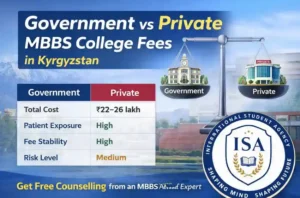
Government vs Private MBBS Fees in Kyrgyzstan – Detailed Comparison
Government vs Private College Fees Government vs Private College Fees Blogs ... -
Year-Wise MBBS Fee Structure in Kyrgyzstan (2026 Guide)
Year-Wise MBBS Fee Structure in Kyrgyzstan (2026 Guide) Blogs About Us Year-wise... -
MBBS Fees in Kyrgyzstan 2026 – Total Cost & Fees in Rupees
Does NMC Recognize Georgian Medical Universities? Complete Truth for Indian Students... -
Does NMC Recognize Georgian Medical Universities? Complete Truth (2026)
Does NMC Recognize Georgian Medical Universities? Complete Truth for Indian Students... -
How to Check NMC Compliance of Georgian Medical Universities (2026 Guide)
Will My MBBS Degree from Abroad Be Valid in India? (2026... -
NMC Rules for MBBS in Georgia 2026 | FMGLR 2021 Explained in Detail
Will My MBBS Degree from Abroad Be Valid in India? (2026...